
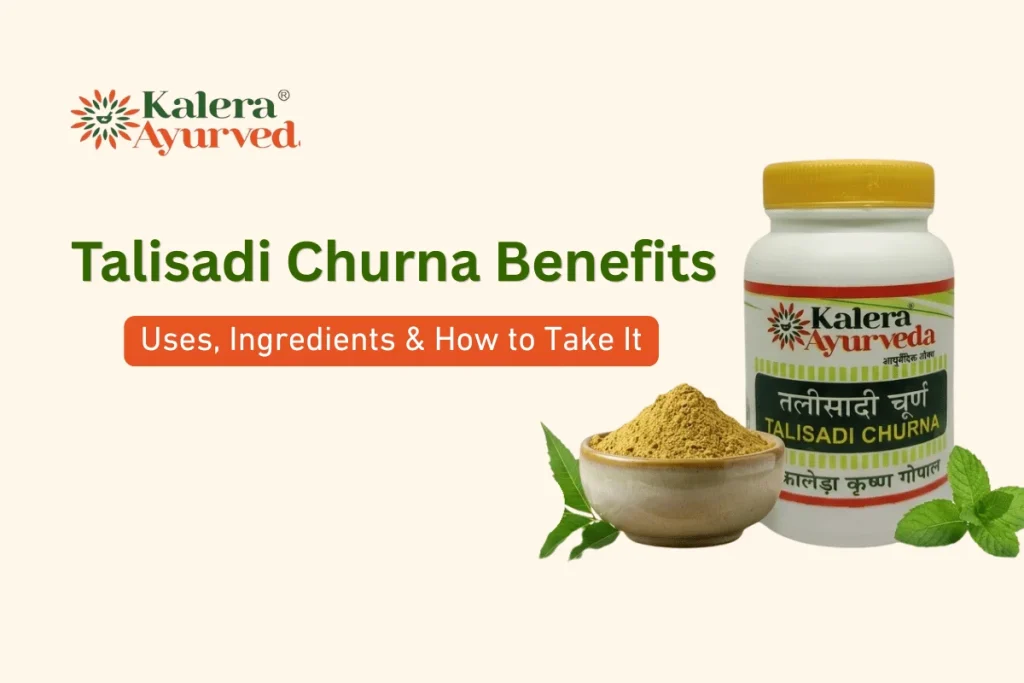
Talisadi Churna Benefits: Understanding This Ayurvedic Formulation
Talisadi Churna Benefits are traditionally associated with respiratory comfort, cough support, throat irritation and digestive wellness. Talisadi Churna is a classical Ayurvedic powdered formulation prepared from a combination of herbs and aromatic spices rather than a single plant.
The formulation is commonly discussed in relation to Kasa (cough), Kapha-related respiratory discomfort, reduced appetite and digestive sluggishness. Modern product descriptions also commonly position it for cough, cold, throat irritation, bloating and digestion.
However, the way Talisadi Churna is traditionally used depends on the nature of the symptoms, the person’s digestive strength and the vehicle used with the powder. It should therefore not be treated as a universal remedy for every type of cough or digestive complaint.
What Is Talisadi Churna?
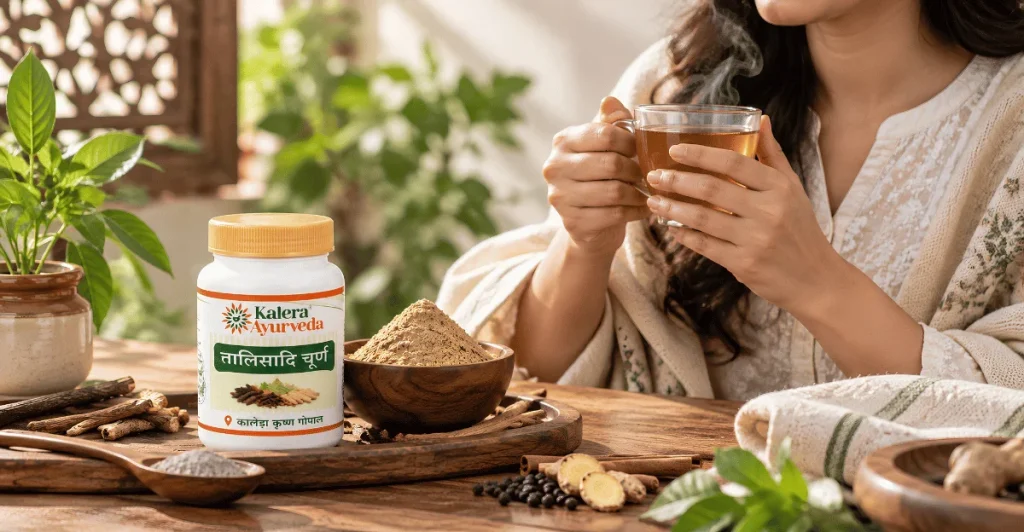
Talisadi Churna is a traditional Ayurvedic Churna, meaning a powdered herbal formulation. Its commonly described ingredients include Talisapatra, Pippali, Maricha, Shunthi, Vamshalochana, Ela, Tvak and Sharkara or Mishri. The exact proportions can vary between classical references and commercial preparations.
The formulation combines pungent, warming and aromatic ingredients with Mishri. From an Ayurvedic perspective, these ingredients are traditionally used where Kapha, mucus, reduced appetite or weak digestion are considered relevant.
Kalera Ayurveda’s current Talisadi Churna is available in a 100 g pack and is described for traditional respiratory and digestive support, including cough, cold, throat irritation, bloating and appetite-related concerns
Talisadi Churna Ingredients and Their Traditional Roles
The ingredients are an important part of understanding this formulation.
| Ingredient | Common name | Traditional role |
|---|---|---|
| Talisapatra | Indian Silver Fir | Traditionally associated with respiratory support |
| Pippali | Long Pepper | Traditionally used for digestion and respiratory wellness |
| Maricha | Black Pepper | Traditionally associated with Kapha and digestive balance |
| Shunthi | Dry Ginger | Traditionally used to support Agni and digestion |
| Vamshalochana | Bamboo manna | Traditionally included in respiratory formulations |
| Ela | Cardamom | Aromatic ingredient traditionally used for digestion |
| Tvak | Cinnamon | Warming and aromatic herb |
| Mishri/Sharkara | Sugar candy | Traditional sweet component of the formulation |
Current commercial descriptions from 1mg and Baidyanath list these same core ingredients, although the exact quantity and formulation can differ between manufacturers.
This is also why it is better to discuss Talisadi Churna as a complete formulation rather than attributing all of its traditional uses to one particular ingredient.
7 Talisadi Churna Benefits and Traditional Uses
1. Supports Cough and Throat Comfort
One of the most common traditional uses of Talisadi Churna is for cough and associated throat discomfort.
The combination of Talisapatra, Pippali, Maricha, Shunthi and Vamshalochana is traditionally associated with respiratory wellness. Commercial Ayurvedic references commonly describe the formulation for cough, cold and throat irritation.
The exact suitability can depend on whether the cough is dry, associated with mucus or accompanied by other symptoms.
2. Traditionally Used for Respiratory Wellness
Talisadi Churna is frequently used in Ayurvedic formulations intended to support the respiratory tract.
Its warming and aromatic ingredients are traditionally associated with Kapha-related respiratory discomfort and congestion. This makes it a common formulation in Ayurvedic cough-care routines.
It should not, however, be presented as a replacement for medical treatment for asthma, pneumonia, severe breathing difficulty or other significant respiratory conditions.
3. May Support Digestion
Talisadi Churna is not only associated with respiratory use. Its pungent ingredients, particularly ginger, black pepper and long pepper, are traditionally used to support Agni, or digestive function.
This is why many Ayurvedic references discuss Talisadi Churna in relation to indigestion, reduced appetite and other mild digestive complaints.
For people looking for a digestive formulation specifically, Kalera Ayurveda also offers Hingwashtak Churna, which has a different ingredient profile and traditional digestive focus.
4. Supports Appetite
Reduced appetite can sometimes occur alongside indigestion or a feeling of heaviness after meals.
The warming spices in Talisadi Churna are traditionally used to support digestive activity and appetite. Current product references also describe the formulation as supporting digestion and appetite.
Persistent loss of appetite, unexplained weight loss or appetite changes lasting for a long period should be medically evaluated rather than managed only with an Ayurvedic formulation.
5. May Help With Bloating and Digestive Discomfort
Ingredients such as Shunthi, Pippali, Maricha, Ela and Tvak are traditionally used in digestive formulations.
For this reason, Talisadi Churna is commonly discussed for occasional bloating, indigestion and digestive discomfort. PharmEasy also describes traditional use in digestive complaints including flatulence and indigestion.
The formulation should still be used according to the product’s recommended amount, especially because excessive intake of pungent ingredients can cause digestive irritation in some people.
6. Provides Traditional Support During Seasonal Respiratory Discomfort
Cough, throat irritation and congestion are common concerns during seasonal changes.
Talisadi Churna is traditionally included in Ayurvedic respiratory-care routines because of its combination of warming spices and herbs. This traditional use is different from claiming that the formulation prevents every respiratory infection.
Good hydration, adequate rest and appropriate medical care remain important when respiratory symptoms are persistent or severe.
7. Combines Respiratory and Digestive Support
One of the useful characteristics of Talisadi Churna is that its traditional applications are not limited to one body system.
The same formulation contains ingredients traditionally associated with both respiratory comfort and digestive function. This explains why Talisadi Churna appears in Ayurvedic discussions involving cough, appetite and digestion together.
This combined traditional profile is also one reason the formulation should be selected according to the individual’s symptoms rather than simply using it whenever a cough occurs.
How to Take Talisadi Churna?
The appropriate amount depends on the specific product and the individual’s needs.
For Kalera Ayurveda Talisadi Churna, the current product information states that adults may take 1–3 grams once or twice daily with honey or warm water, or as directed by a physician.
Different manufacturers may provide different instructions. For example, 1mg currently lists 1.5–2 g twice daily for one Talisadi Churna product, while other commercial products give different amounts. This demonstrates why the dosage printed on the specific product should take priority over a generic internet recommendation.
Talisadi Churna With Honey
Honey is traditionally used as an Anupana, or vehicle, with certain Ayurvedic formulations.
Kalera Ayurveda currently recommends honey or warm water for its Talisadi Churna.
The choice of vehicle can vary according to the formulation and traditional purpose, so users should follow the product label or advice from a qualified Ayurvedic practitioner.
Talisadi Churna With Warm Water
Warm water provides a simple way to take the powder, particularly when the formulation is being used as part of a general digestive or respiratory wellness routine.
Kalera Ayurveda specifically lists warm water as one of the ways to consume its Talisadi Churna.
Important: Do not assume that the dosage or vehicle recommended for another manufacturer’s Talisadi Churna automatically applies to Kalera’s product.
Talisadi Churna for Dry Cough: What Should You Know?
Talisadi Churna is frequently searched for dry cough, and Ayurvedic references traditionally associate the formulation with cough-related complaints.
However, cough is a symptom rather than a single condition. Dry cough may occur because of throat irritation, allergies, viral illness, reflux, medication effects or other causes.
Some Ayurvedic references suggest using Talisadi Churna with ghee for dry cough, while other products recommend honey. These recommendations vary according to the formulation and traditional approach.
Therefore, it is better to follow the instructions of the particular product or a qualified practitioner rather than mixing different dosage recommendations from different sources.
Talisadi Churna vs Sitopaladi Churna
Talisadi Churna and Sitopaladi Churna are both traditional Ayurvedic powdered formulations commonly associated with respiratory and digestive wellness, but they are not identical formulations.
Their ingredients and proportions differ. 1mg notes that the two formulations have similarities but differ in ingredient ratios, including differences involving Vamshalochana.
Therefore, choosing between them should depend on the formulation, symptoms and professional guidance rather than assuming one is universally better.
For another respiratory-oriented Ayurvedic formulation, Kalera Ayurveda also offers Sitopaladi Churna if available in its current product range.
Safety, Precautions and Possible Side Effects
Talisadi Churna is generally used in small quantities, but “natural” does not automatically mean that unlimited use is appropriate.
Kalera Ayurveda notes that excessive consumption may cause burning sensation, loose motions or stomach upset, and advises medical guidance for children and consultation during pregnancy or breastfeeding.
Keep these points in mind:
- Follow the dosage on the product label.
- Do not exceed the recommended amount.
- Children should not be given adult doses without professional guidance.
- People with ongoing medical conditions should seek appropriate advice before use.
- If you are taking regular medicines, discuss herbal formulations with your healthcare professional.
- Stop use if you experience an unusual reaction.
- Seek medical care for persistent cough, breathing difficulty, high fever or worsening symptoms.
Because Kalera’s formulation contains Mishri/sugar candy, people who need to monitor sugar intake should take this into consideration before using the product.
What Does Research Say About Talisadi Churna?
Modern research on Talisadi Churna is more limited than the large amount of traditional and commercial information available online.
A study indexed in PubMed examined the standardisation of Talisadya Churna and compared preparation methods, including differences in extraction and physicochemical characteristics. The study focused on standardisation rather than proving clinical effectiveness for cough or digestive disorders.
This distinction is important. Traditional Ayurvedic use and product descriptions can explain how a formulation has historically been used, but they should not automatically be interpreted as clinical proof that Talisadi Churna treats a specific disease.
PubMed – Studies on the Standardisation of Talisadya Curna
Frequently Asked Questions
What are the main Talisadi Churna benefits?
The main traditional uses of Talisadi Churna are associated with respiratory comfort, cough, throat irritation, digestion and appetite. Its combination of warming and aromatic ingredients makes it a commonly discussed Ayurvedic formulation for both respiratory and digestive wellness. These are traditional uses and should not be interpreted as guaranteed treatment outcomes.
Is Talisadi Churna good for cough?
Talisadi Churna is traditionally used for cough and related throat or respiratory discomfort. Several Ayurvedic product references describe it for cough and cold support. However, the appropriate formulation and anupana can depend on the type of cough, and persistent or severe cough should be medically evaluated.
How much Talisadi Churna should I take?
Dosage varies between manufacturers. Kalera Ayurveda currently recommends 1–3 grams once or twice daily for adults, with honey or warm water, or as directed by a physician. Other products give different amounts, so always follow the instructions for the specific product rather than combining dosage information from different brands.
Can Talisadi Churna be taken with honey?
Yes, honey is traditionally used as a vehicle with Talisadi Churna, and Kalera Ayurveda currently lists honey as one of the recommended ways to take its product. The appropriate vehicle can depend on the individual and the intended traditional use, so professional guidance may be useful for ongoing use.
Does Talisadi Churna help with digestion?
Talisadi Churna contains ingredients such as Shunthi, Pippali, Maricha, Ela and Tvak that are traditionally used to support digestive function. Commercial and Ayurvedic references commonly associate the formulation with indigestion, bloating and reduced appetite. Persistent digestive symptoms, however, should be evaluated to identify their underlying cause.
Is Talisadi Churna safe for children?
Children should not automatically be given the adult dosage. Kalera Ayurveda specifically advises medical guidance for children. The appropriate amount depends on age, health status, formulation and the reason for use, so a qualified healthcare professional should guide pediatric use.
Final Takeaway
Talisadi Churna is a traditional Ayurvedic polyherbal formulation with a distinctive combination of respiratory and digestive uses. Its traditional applications include cough and throat comfort, respiratory wellness, digestion, appetite and occasional digestive discomfort.
The formulation contains several warming and aromatic ingredients, including Talisapatra, Pippali, Maricha, Shunthi, Vamshalochana, Ela and Tvak, along with Mishri in the classical-style preparation.
For Kalera Ayurveda’s product, the current guidance is to use 1–3 grams once or twice daily with honey or warm water for adults, or as directed by a physician. Because formulations and dosages can vary between manufacturers, the specific product label should always be followed.
For persistent cough, breathing difficulty, prolonged digestive problems or other concerning symptoms, Ayurvedic self-care should not replace appropriate medical evaluation.