
Haridra Khand for Skin is a traditional Ayurvedic formulation commonly associated with skin wellness, especially concerns such as itching, rashes and allergic skin reactions. Haridra, or turmeric, is the main ingredient around which this formulation is built, along with other herbs traditionally used for digestion and overall wellness.
Kalera Ayurveda’s Haridra Khand contains Haridra, Triphala, Pippali, Cardamom, Cinnamon, Nagkesar and Mishri. The current formulation is described by Kalera Ayurveda as supporting skin health, digestion, immunity and seasonal wellness. Kalera Ayurveda
While Haridra Khand has traditional Ayurvedic applications, it is important to understand the difference between traditional use and modern clinical evidence. Research on turmeric and curcumin shows potential in several areas of skin health, but researchers also note that more high-quality clinical studies are needed. PubMed
What Is Haridra Khand?
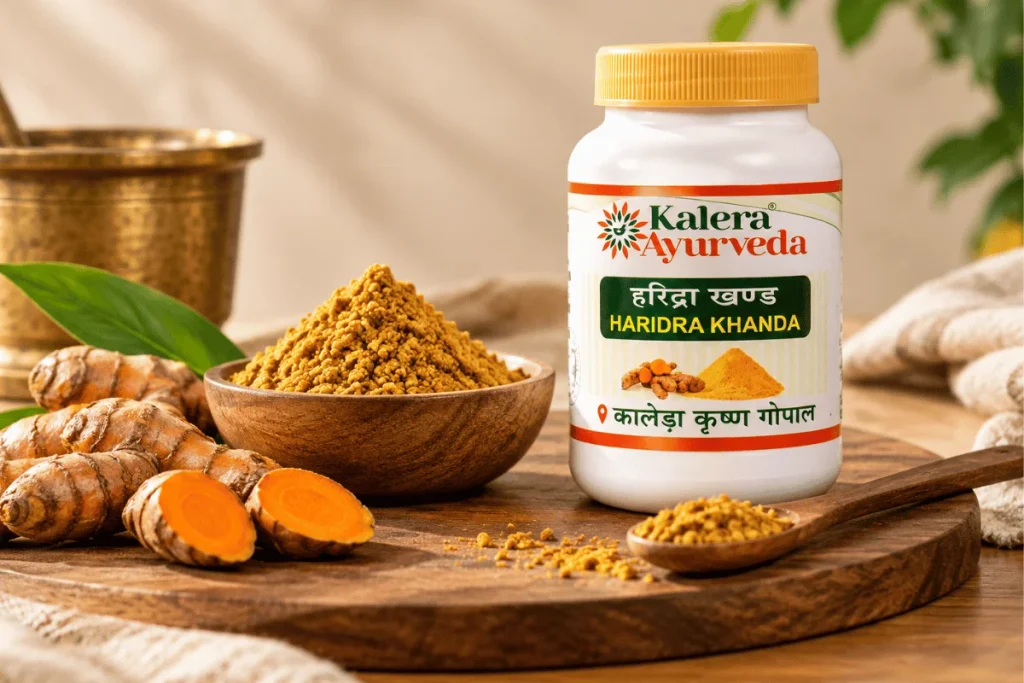
Haridra Khand is a traditional Ayurvedic preparation made using Haridra (turmeric) along with other herbs and supporting ingredients.
The formulation is traditionally associated with skin-related concerns such as itching and allergic reactions. It is also used within Ayurveda in connection with digestive and respiratory wellness.
The exact composition can vary between manufacturers. Kalera Ayurveda’s current Haridra Khand contains the following ingredients:
| Ingredient | Traditional Ayurvedic role |
|---|---|
| Haridra (Turmeric) | Traditionally associated with skin wellness and inflammatory balance |
| Triphala | Traditionally used for digestion and general wellness |
| Pippali | Traditionally used to support digestion and respiratory wellness |
| Cardamom | Traditionally valued for digestive support |
| Cinnamon | Traditionally used in digestive and metabolic wellness |
| Nagkesar | Traditionally associated with skin wellness |
| Mishri | Used as part of the formulation |
Kalera Ayurveda currently offers its Haridra Khand in a 100 g pack. Kalera Ayurveda
Haridra Khand for Skin: Traditional Uses and Benefits
Supports Skin Wellness
Haridra Khand is traditionally used as part of Ayurvedic approaches to maintaining healthy skin. Its main ingredient, Haridra, has a long history of use in traditional Indian medicine.
The formulation is commonly associated with concerns such as itching, rashes and allergic skin reactions. However, it should be viewed as a traditional wellness formulation rather than a guaranteed treatment for a particular skin disease.
Traditionally Used for Itching
Itching is one of the common traditional uses associated with Haridra Khand.
Ayurvedic formulations containing Haridra are traditionally used when skin discomfort is associated with allergic or inflammatory responses. The other herbs in the formulation are intended to complement the overall preparation.
Persistent itching should not always be assumed to be a simple allergy. It can also occur with eczema, infections, medication reactions and other skin conditions. If symptoms continue or become severe, professional evaluation is important.
May Support Healthy-Looking Skin
Haridra Khand is also traditionally associated with maintaining healthy skin and complexion.
Turmeric contains curcuminoids, including curcumin, which have been investigated for their antioxidant and inflammatory effects. Research has explored turmeric and curcumin in conditions including pruritus, psoriasis, dermatitis and other skin concerns, although the strength of evidence varies between conditions. PubMed
This does not mean Haridra Khand should be considered a skin-whitening product. Healthy skin appearance depends on many factors, including nutrition, sun exposure, skincare and overall health.
Provides Traditional Antioxidant Support
Turmeric is one of the most extensively researched ingredients in Haridra Khand.
Curcumin has been studied for its antioxidant and inflammatory pathways. A systematic review of clinical evidence found early indications of potential benefits from turmeric and curcumin products for some aspects of skin health, while also noting that the available studies remain limited. PubMed
Therefore, it is more appropriate to describe this as potential supportive value rather than a proven treatment effect.
Traditionally Associated With Allergic Skin Complaints
Haridra Khand has a particular place in traditional Ayurvedic use for allergic-type skin complaints.
A 2024 pharmacological study investigated Haridra Khanda in experimental allergy models and reported activity relevant to allergy-related mechanisms. However, the study was experimental rather than a clinical trial proving effectiveness for human skin allergies. PubMed
This distinction is important when discussing Ayurvedic formulations responsibly.
Supports Digestive Wellness
Haridra Khand is not exclusively a skin-focused formulation.
Ingredients such as Triphala and Pippali have traditional applications in digestive wellness. Kalera Ayurveda also describes its formulation as supporting digestion along with skin and general wellness. Kalera Ayurveda
This makes the formulation different from a topical skin product because it is intended for internal use.
Haridra Khand Ingredients and Their Traditional Roles
The combination of ingredients is an important part of understanding Haridra Khand.
Haridra (Turmeric) is the central ingredient and is traditionally valued for skin and general wellness.
Triphala is a combination of three Ayurvedic fruits traditionally used to support digestion and regular elimination.
Pippali is a traditional Ayurvedic spice commonly included in formulations intended to support digestion and respiratory wellness.
Cardamom and Cinnamon are aromatic herbs traditionally used for digestive support and overall balance.
Nagkesar is traditionally used in several Ayurvedic preparations, including formulations associated with skin wellness.
Mishri is included as part of Kalera’s preparation and provides sweetness to the formulation. Kalera Ayurveda
Because formulations can differ between manufacturers, readers should always check the ingredient list of the specific product they are purchasing.
How to Take Haridra Khand
The recommended dosage depends on the particular formulation and manufacturer.
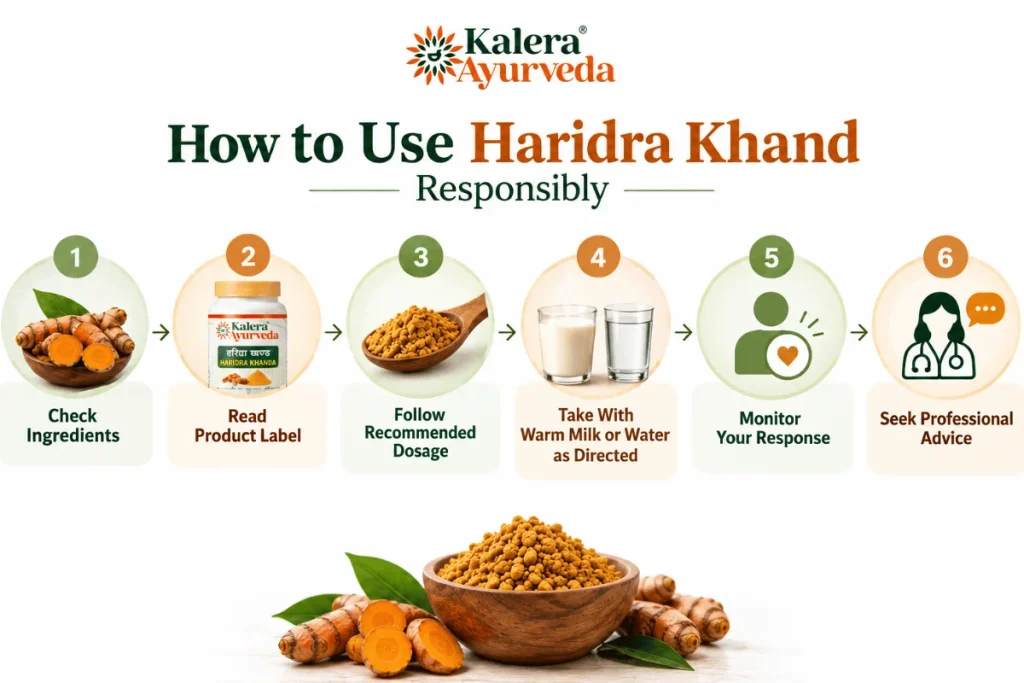
For Kalera Ayurveda Haridra Khand, the current product information suggests 1–2 teaspoons once or twice daily, mixed with warm milk or water and preferably taken after meals. The product page also recommends consulting a qualified healthcare provider for specific health concerns. Kalera Ayurveda
A simple approach is:
- Measure the recommended quantity.
- Mix it with warm milk or water.
- Take it according to the product instructions.
- Do not exceed the recommended amount.
- Follow the storage and expiry instructions on the package.
If you are using another manufacturer’s Haridra Khand, follow that product’s label because ingredients and dosage can vary.
Can Haridra Khand Be Applied Directly to the Skin?
Haridra Khand intended for oral consumption should not be applied directly to the face or skin unless the manufacturer specifically states that the formulation is suitable for external use.
This is important because turmeric itself is commonly used in traditional topical preparations, but an oral Haridra Khand contains multiple ingredients prepared specifically for internal consumption.
For readers looking for an Ayurvedic formulation designed specifically for external skin use, Kalera Ayurveda also has Charm Rog Nashak Tail, which belongs to a different product category and should be used according to its own directions.
Haridra Khand vs Turmeric Powder
Haridra Khand and ordinary turmeric powder are not the same.
Turmeric powder primarily contains turmeric, whereas Haridra Khand is a multi-ingredient Ayurvedic formulation prepared using a combination of herbs.
Kalera’s formulation includes Haridra along with Triphala, Pippali, Cardamom, Cinnamon, Nagkesar and Mishri. Kalera Ayurveda
Therefore, simply adding kitchen turmeric to food or milk is not equivalent to taking Haridra Khand.
Other Ayurvedic Formulations for Skin Wellness
Haridra Khand is an internal formulation. Ayurveda also uses different preparations depending on how a formulation is intended to be used.
For example, Panchtikta Ghrit is a medicated ghee formulation containing herbs such as Neem, Vasa, Patola, Guduchi and Kantakari. Its product positioning is different from Haridra Khand and is associated with skin and general wellness.
This illustrates why Ayurvedic products should be selected according to their formulation, ingredients and intended method of use, rather than choosing products only because they are associated with skin health.
What Does Research Say About Turmeric and Skin Health?
Modern research has investigated turmeric and curcumin for several areas of dermatology.
A systematic review published in Phytotherapy Research evaluated human clinical studies involving turmeric or curcumin and skin health. The review found early evidence of potential benefits across several dermatological conditions, but also noted that the number and quality of available studies were limited. PubMed
A later systematic review of randomized controlled trials also found evidence of potential effects for some conditions, including pruritus, while the strength of evidence differed across other dermatological conditions. PubMed
Readers interested in the scientific literature can explore the PubMed research on turmeric and skin health.
Haridra Khand Safety and Precautions
Haridra Khand should be taken according to the manufacturer’s instructions.
Keep the following points in mind:
- Check the complete ingredient list before use.
- Follow the recommended dosage.
- Do not take more than the suggested amount.
- Avoid the product if you have a known allergy to any ingredient.
- Children should use Ayurvedic medicines only with appropriate professional guidance.
- Pregnant or breastfeeding women should consult a qualified healthcare professional before use.
- If you take regular medicines or have an existing health condition, discuss the product with your healthcare provider.
- Persistent or severe skin symptoms should be medically evaluated.
- Store the product in a cool, dry place away from direct sunlight.
- Keep the container tightly closed and out of children’s reach.
It is also important to remember that natural ingredients can still cause unwanted reactions in some people.
Frequently Asked Questions
Is Haridra Khand good for skin?
Haridra Khand has a traditional Ayurvedic association with skin wellness, particularly itching, rashes and allergic skin complaints. Turmeric and curcumin have also been studied in several areas of dermatology. However, research findings vary by condition and formulation, so Haridra Khand should not be presented as a guaranteed treatment for a skin disease.
What is Haridra Khand mainly used for?
Haridra Khand is traditionally associated with skin concerns such as itching, rashes and allergic reactions. Some formulations are also used traditionally for digestive and respiratory wellness. The exact uses can vary depending on the formulation and manufacturer’s product information.
Can I apply Haridra Khand directly to my face?
No, an oral Haridra Khand formulation should not be applied directly to the face unless the manufacturer specifically states that it is intended for external use. Oral and topical Ayurvedic preparations are formulated differently and should be used according to their intended method of application.
How should I take Kalera Haridra Khand?
Kalera Ayurveda currently suggests 1–2 teaspoons once or twice daily with warm milk or water, preferably after meals. However, always check the product label before use because dosage recommendations can change and may differ between formulations. Kalera Ayurveda
Does Haridra Khand help with itching?
Itching is one of the traditional uses associated with Haridra Khand. Its Haridra-based formulation is traditionally used for skin wellness and allergic-type complaints. However, recurring or severe itching can have many causes and should be assessed by a healthcare professional rather than treated only through self-medication.
Can Haridra Khand be taken daily?
Kalera’s current product information provides daily usage directions, but whether prolonged use is appropriate depends on the individual and the reason for taking it. Follow the product label and consult a qualified professional if you plan to use it for an extended period or have an existing health condition.
Final Takeaway
Haridra Khand is a traditional Ayurvedic formulation based on Haridra (turmeric) and combined with other herbs such as Triphala, Pippali, Cardamom, Cinnamon and Nagkesar.
For Haridra Khand for skin, its traditional focus is mainly associated with skin wellness, itching, rashes and allergic-type complaints. Kalera Ayurveda also describes its formulation as supporting digestion and general wellness. Kalera Ayurveda
Modern research on turmeric and curcumin provides some promising findings for skin health, but the evidence is still developing and cannot be directly treated as proof that every Haridra Khand formulation will produce the same effects. PubMed
When choosing Haridra Khand, look at the actual ingredients, dosage, preparation, manufacturer information and intended use. For persistent, severe or unexplained skin symptoms, professional medical advice is important.