
Narayan Tail for Joint Pain: Understanding Its Traditional Use
Narayan Tail for Joint Pain is a traditional Ayurvedic approach that focuses on external oil application and massage around areas affected by stiffness, muscle discomfort and reduced mobility.
Narayan Tail, also called Narayana Taila in Ayurvedic literature, is a multi-herbal oil traditionally associated with Vata-related musculoskeletal conditions. Modern product formulations can vary, but the oil is commonly used as a massage oil for joints, muscles and other areas where physical comfort is needed.
Current research has also examined Narayana Taila as part of Ayurvedic management approaches for knee osteoarthritis. However, it is important to note that the available clinical studies generally evaluate Narayana Taila alongside other Ayurvedic interventions rather than proving the effect of the oil alone.
What Is Narayan Tail?
Narayan Tail is a classical Ayurvedic herbal oil prepared using a combination of herbs and an oil base. Traditional formulations can contain herbs such as Ashwagandha, Bala, Atibala, Bilva, Agnimantha, Shyonaka, Patala, Punarnava and Gokshura, along with sesame oil and other ingredients depending on the preparation.
The formulation is traditionally associated with Vata balance, which is an important concept in Ayurvedic approaches to musculoskeletal wellness. The oil is generally applied externally through massage rather than used like a conventional pain tablet.
Kalera Ayurveda’s current Narayan Tail is described as a classical Ayurvedic oil intended for external application, with traditional use focused on muscle comfort, joint flexibility, relaxation and general wellness.
For readers interested in other traditional oils, Kalera Ayurveda also has an Ayurvedic Oil collection covering different types of external-use formulations.
7 Narayan Tail Benefits and Traditional Uses
1. Supports Joint Comfort
One of the main reasons people look for Narayan Tail for joint pain is its traditional use in joint-care routines.
Gentle massage with a suitable Ayurvedic oil can provide a warming and soothing experience around areas such as the knees, shoulders, elbows and other joints. Narayan Tail is traditionally used as part of external care when discomfort is accompanied by stiffness or a feeling of restricted movement.
It should be viewed as supportive external care rather than a guaranteed treatment for an underlying joint disease.
2. May Help With Joint Stiffness
Stiffness can become noticeable after prolonged sitting, physical activity or periods of inactivity.
Traditional Ayurvedic oil massage is commonly used to keep joints and surrounding muscles comfortable and flexible. Narayan Tail is particularly associated with Vata-oriented external care, making massage an important part of how the oil is traditionally used.
Regular massage may also become a simple self-care practice for people who experience occasional muscular tightness.
3. Supports Muscle Relaxation
Narayan Tail is not limited to joints. It is also traditionally used for muscular comfort.
A gentle massage can help relax areas that feel tight after exercise, physical work or everyday activity. The massage itself also contributes to the overall relaxing effect, so the experience should not be attributed only to the herbal ingredients.
Current commercial descriptions of Narayana/Mahanarayana oils similarly position them around muscle relaxation, joint comfort and external massage.
4. Traditionally Used for Back and Body Comfort
The traditional use of Narayana Taila extends beyond individual joints. Ayurvedic sources and product references commonly describe its use in external massage for areas such as the back and other parts of the musculoskeletal system.
For people who spend long hours sitting or performing physically demanding activities, a gentle oil massage can be incorporated into a broader routine involving stretching, movement and adequate rest.
5. May Support Better Mobility
Joint discomfort and stiffness can make normal movement feel less comfortable.
Traditional massage with Narayan Tail aims to support flexibility and ease of movement by keeping the surrounding muscles and joints comfortable. Kalera Ayurveda also specifically describes its Narayan Tail as being traditionally used to support joint flexibility.
For persistent mobility problems, however, massage should not replace professional assessment.
6. Useful as Part of an Ayurvedic Massage Routine
Narayan Tail can be incorporated into an external Ayurvedic massage routine, commonly known as Abhyanga.
The purpose of such massage is not simply to apply oil to the skin. Gentle, consistent movements are traditionally used to provide warmth, relaxation and a sense of physical ease.
The amount of oil and duration of massage can depend on the formulation, the area being massaged and individual needs, so following the product label is preferable.
7. Supports General Musculoskeletal Wellness
Narayan Tail can also be used as part of general musculoskeletal self-care rather than only when pain is already present.
Combining appropriate oil massage with regular movement, stretching, healthy body weight, good posture and adequate recovery can provide a more complete approach to joint and muscle wellness.
For people already using Ayurvedic joint-care products, Kalera’s Yograj Guggal and Mahayograj Guggul are different formulations intended for traditional joint and musculoskeletal wellness. They should not be considered substitutes for an external massage oil.
What Does Research Say About Narayan Tail for Joint Pain?
Clinical research has also examined Narayana Taila as part of Ayurvedic approaches to knee osteoarthritis. A multicentre study evaluated Narayana Taila along with other Ayurvedic interventions and reported improvements in pain, stiffness and physical function. Since the study involved multiple treatments together, these findings should not be taken as proof that Narayan Tail alone can treat osteoarthritis. You can read the published study on PubMed – Narayana Taila and Knee Osteoarthritis.
Research on Narayana Taila provides some useful context, particularly around knee osteoarthritis.
A multicentre prospective study published in the Journal of Ayurveda and Integrative Medicine evaluated 142 people with knee osteoarthritis. Participants received a combination of Vatari Guggulu, Maharasnadi Kwatha and external Narayana Taila massage for 12 weeks. The study reported significant improvements in pain, stiffness, physical function and WOMAC scores.
More recently, a 2025 multicentre study involving 483 participants evaluated Yograj Guggulu, Ashwagandha Churna and local application of Narayana Taila for knee osteoarthritis. Significant improvements were reported in WOMAC and pain scores, with no adverse events reported during the study.
However, there is an important limitation: these studies evaluated Narayana Taila as part of a combined Ayurvedic treatment protocol. Therefore, their results should not be interpreted as proof that Narayan Tail alone treats osteoarthritis or eliminates joint pain.
This distinction is important when choosing an Ayurvedic product for long-term joint care.
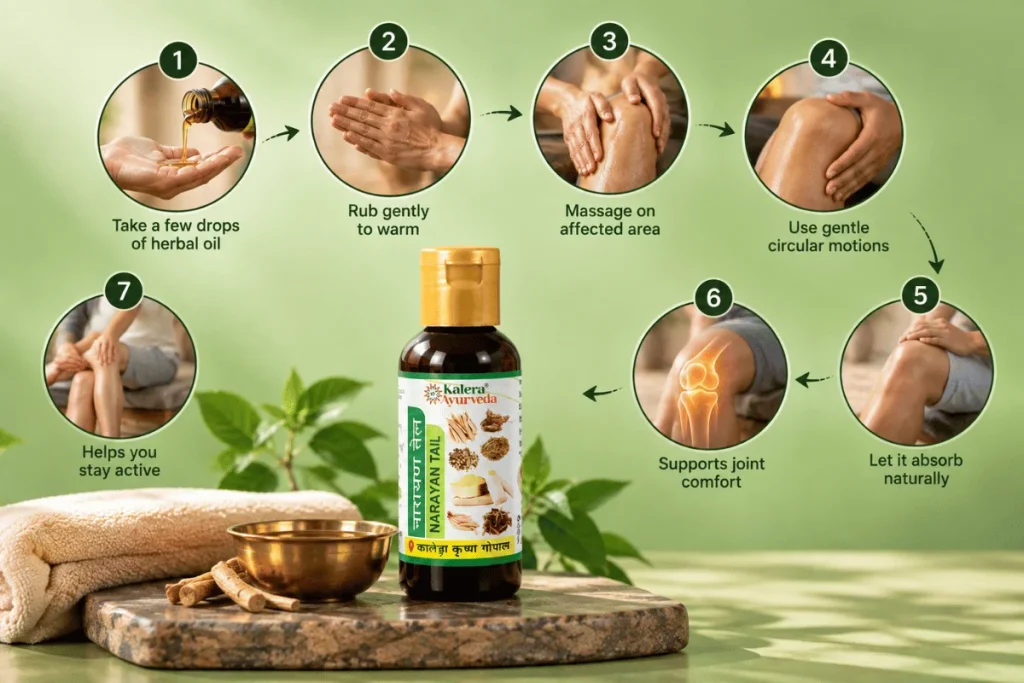
How to Apply Narayan Tail for Joint Pain?
For general external massage, a simple approach can be followed:
- Take a small amount of oil according to the product instructions.
- Apply it over the area requiring massage.
- Massage gently using comfortable circular or smooth movements.
- Continue for several minutes without applying excessive pressure.
- Leave the oil for the period recommended on the product label.
- Bathe or clean the area afterward if required.
Some traditional practices use mildly warmed oil for massage, but the oil should never be excessively hot.
For Kalera Ayurveda Narayan Tail, the current product instructions specify external application, gentle massage and following the label or guidance of a qualified Ayurvedic practitioner.
Narayan Tail vs Other Ayurvedic Joint Oils
Not every Ayurvedic oil serves the same purpose, and formulations can differ significantly.
Narayan Tail is traditionally associated with broader musculoskeletal massage and Vata-oriented care. Other oils may have different ingredients and intended uses.
For example, Peedashamak Tail is another Kalera Ayurveda external oil that can be considered within a broader Ayurvedic pain-care category.
The important point is to select an oil according to its formulation and intended use rather than assuming that every Ayurvedic massage oil works in the same way.
Who Should Be Careful With Narayan Tail?
Narayan Tail is intended for external use, but that does not mean every type of joint pain should be self-managed with massage.
Take extra care if:
- The joint is severely swollen, red or unusually hot.
- Pain started suddenly after a significant injury.
- There is suspected fracture or ligament damage.
- There is an open wound or damaged skin at the application site.
- Pain is persistent or progressively worsening.
- There is numbness, weakness or difficulty using the affected limb.
- You have a diagnosed medical condition requiring ongoing treatment.
Avoid applying oil over broken or irritated skin unless a qualified healthcare professional specifically recommends it.
For persistent knee or joint pain, a proper diagnosis is important because arthritis, injury, nerve problems and other conditions can produce similar symptoms.
Frequently Asked Questions
Is Narayan Tail good for joint pain?
Narayan Tail is traditionally used as an external Ayurvedic massage oil for joint and muscle comfort. It may be incorporated into routines focused on stiffness, flexibility and relaxation. Clinical research has studied Narayana Taila as part of combined Ayurvedic protocols for knee osteoarthritis, but evidence for the oil alone remains limited.
Can Narayan Tail be used for knee pain?
Yes, Narayan Tail is commonly used externally around the knee as part of Ayurvedic massage practices. Research studies have also evaluated local Narayana Taila application in people with knee osteoarthritis. However, persistent or severe knee pain should be assessed by a qualified healthcare professional rather than managed only with oil massage.
How often can Narayan Tail be applied?
The frequency depends on the specific product formulation and its label instructions. Kalera Ayurveda recommends using its Narayan Tail according to the product label or guidance from a qualified Ayurvedic practitioner. Avoid assuming that the dosage or frequency mentioned for another manufacturer’s Mahanarayan or Narayana Tail applies to Kalera’s formulation.
Can Narayan Tail be used for muscle stiffness?
Narayan Tail is traditionally used for muscle comfort and relaxation, making it suitable for external massage routines aimed at stiffness and physical fatigue. Gentle massage may also contribute to relaxation. It should not, however, be considered a treatment for an undiagnosed muscular or neurological condition.
Should Narayan Tail be warmed before massage?
Some Ayurvedic massage practices use mildly warm oil because it can make the massage more comfortable. If you choose to warm it, the oil should be only gently warm and never hot enough to irritate or burn the skin. Always follow the instructions provided with the particular product.
Can Narayan Tail cure arthritis?
Narayan Tail should not be described as a cure for arthritis. Research involving Narayana Taila has reported improvements when it was used as part of broader Ayurvedic treatment protocols for knee osteoarthritis, but these studies do not establish that the oil alone cures the condition.
Final Takeaway
Narayan Tail has an established place in traditional Ayurvedic external massage practices, particularly around joint comfort, stiffness, muscle relaxation and flexibility.
The current evidence is encouraging but should be interpreted carefully because clinical studies have generally evaluated Narayana Taila together with other Ayurvedic medicines and interventions. For everyday wellness, gentle external massage can be a useful supportive practice, while persistent or severe joint symptoms require appropriate professional evaluation.
For those looking for a traditional Ayurvedic oil, Kalera Ayurveda Narayan Tail is currently presented as an external herbal oil for muscle comfort, joint flexibility and relaxation.