

Kasisadi Tail Benefits: Understanding This Ayurvedic Oil
Kasisadi Tail benefits are traditionally discussed in Ayurveda in relation to localized external care, particularly for anorectal conditions such as piles, as well as certain skin and tissue concerns. The formulation is generally understood as a medicated oil rather than an ordinary massage oil.
However, there is an important point to understand before discussing its uses: Kasisadi Tail formulas can vary between manufacturers. Classical formulations described in Ayurvedic literature may contain mineral and herbal ingredients, while current commercial products can use different ingredient combinations.
For example, Kalera Ayurveda’s current Kasisadi Tail is described as an externally applied oil containing Kasis, Musta, Devdaru and sesame oil, with the product page positioning it around muscle and joint comfort and mobility.
At the same time, much of the published clinical research on Kasisadi Taila has evaluated classical or study-specific preparations in the context of Arsha (hemorrhoids) and Parikartika (fissure-in-ano). Therefore, the exact product formulation and intended application should always be checked before use.
What Is Kasisadi Tail?
Kasisadi Tail, also written as Kasisadi Taila or Kashisadi Tail, is an Ayurvedic medicated oil preparation. The name is associated with Kasisa, a mineral ingredient used in traditional formulations.
Classical descriptions of Kasisadi Taila include sesame oil as a base along with various herbal and mineral ingredients. Some documented classical preparations contain ingredients such as Kasisa, Saindhava, Chitraka, Danti, Kushtha and other substances processed with herbal juices or latexes.
This is different from the current Kalera formulation, which lists Kasis, Musta, Devdaru and Til Oil on its product page.
That difference matters because the benefits and application instructions of one Kasisadi formulation should not automatically be transferred to another manufacturer’s product.

Key Ingredients in Kalera Kasisadi Tail
According to the current Kalera product page:
| Ingredient | Traditional relevance |
|---|---|
| Kasis | Traditionally used in external Ayurvedic preparations |
| Musta | Commonly used in traditional Ayurvedic wellness formulations |
| Devdaru | Traditionally associated with balancing and external applications |
| Til Oil | Sesame oil used as the base of the formulation |
Kalera describes its product as an externally used massage oil and recommends applying a small quantity to the desired area with gentle massage.
For people exploring other formulations, Kalera’s Ayurvedic Oil collection contains several oils designed for different traditional purposes.
7 Kasisadi Tail Benefits and Traditional Uses
1. Traditionally Used for Piles-Related Local Care
One of the strongest search-intent themes around Kasisadi Tail is piles or hemorrhoids.
Classical Ayurvedic sources describe Kasisadi Taila in relation to Arsha, and several clinical studies have evaluated Kasisadi Taila as part of local management approaches for hemorrhoids. A recent 2026 randomized comparative clinical study evaluated Kasisadi Taila instillation in patients with first- and second-degree internal hemorrhoids and reported improvements in selected symptoms including bleeding and constipation.
This is useful evidence, but it should not be interpreted as proof that every commercially available Kasisadi Tail product treats piles. The preparation used in a clinical study may differ from a retail product.
2. May Support Local Comfort
Piles and other anorectal problems can involve discomfort, irritation and sensitivity in the affected area.
Traditional Kasisadi Taila use is associated with localized application, and competitor Ayurvedic product information commonly describes it in relation to pain, itching and local discomfort.
For this reason, local comfort is an important part of the traditional discussion around Kasisadi Tail.
However, persistent anal pain or bleeding should not be self-managed indefinitely with oil. Such symptoms can have different causes and may require medical examination.
3. Traditionally Used in Fissure-Related Care
Another commonly discussed use is fissure-in-ano, a condition involving a tear in the anal canal.
A recent case study reported the use of Kaseesadi Taila in a 35-year-old patient with fissure-in-ano symptoms and described improvement following a specific rectal administration protocol.
This is a single case study, so it cannot establish effectiveness for everyone. It does, however, show why Kasisadi Taila continues to be studied in Ayurvedic anorectal care.
Importantly, rectal administration performed in a clinical study should not be copied as a self-treatment method.
4. Traditionally Associated With Local Tissue Care
Kasisadi formulations have also been discussed in traditional and clinical literature for localized tissue and wound-related applications.
A published case report investigated Kasisadi Taila as part of postoperative wound management for an infected sebaceous cyst. The preparation used in that study had a much more extensive classical ingredient profile than the current Kalera formulation.
This again highlights why the exact formulation matters.
Kasisadi Tail should therefore be understood as a traditional external preparation, rather than a universal wound-healing oil.
5. Used Traditionally for Certain Skin Growths
Several Kasisadi Tail product references discuss topical use for corns and warts. These claims are also visible in current competitor product information and Ayurvedic references.
Because these conditions can sometimes be confused with other skin lesions, self-treatment should be approached carefully. Any unusual, changing or persistent growth should be assessed by a qualified healthcare professional.
6. Supports External Massage and Local Comfort
This benefit is particularly relevant to Kalera’s current product positioning.
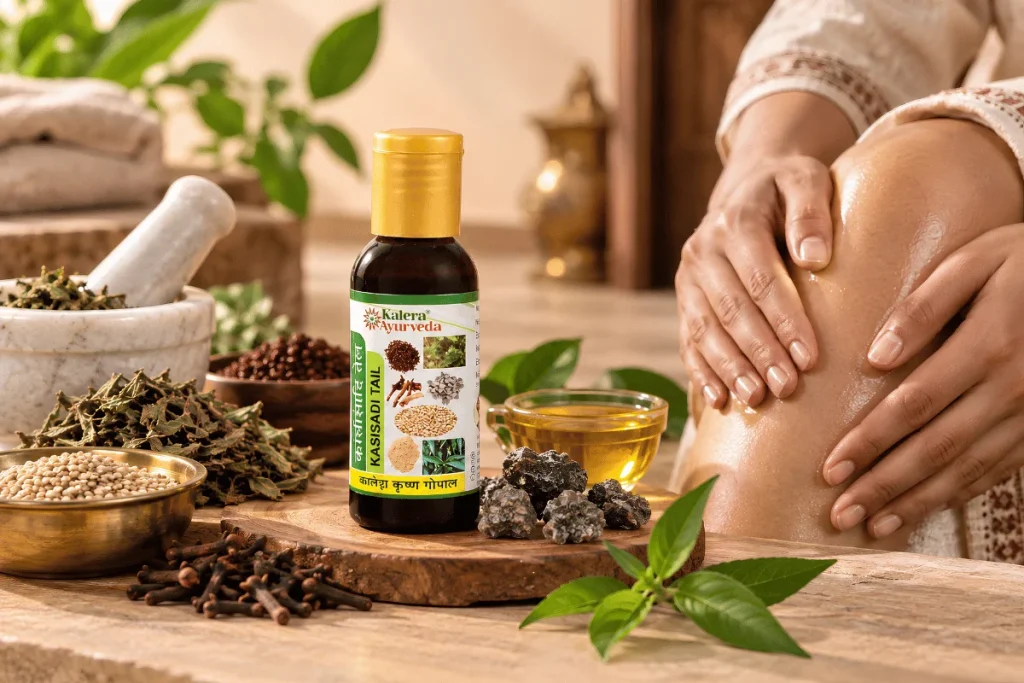
Kalera describes its Kasisadi Tail as an external massage oil made with Kasis, Musta, Devdaru and sesame oil. The product is positioned around muscle and joint comfort and mobility, with gentle massage recommended over the desired area.
This is different from the piles-focused use frequently described for classical Kasisadi Taila online, so readers should follow the instructions of the specific product they are using.
For another Kalera formulation intended specifically for pain-related external care, Peedashamak Tail is a more directly relevant product to explore.
7. Fits Into Traditional Ayurvedic External Care
Ayurvedic oils are formulated for different purposes, and Kasisadi Tail occupies a distinctive place among external preparations.
It should not be treated as interchangeable with every other Ayurvedic oil. For example, Jatyadi Tail is another external-use formulation with a different traditional purpose.
Choosing between Ayurvedic oils should therefore depend on the intended use, formulation and professional guidance rather than simply selecting an oil because it is herbal.
Kasisadi Oil for Piles: What Does the Evidence Say?
The piles-related search intent for Kasisadi Tail is particularly strong, and there is some clinical literature worth understanding.
A 2026 randomized comparative clinical study included 30 participants with first- and second-degree internal hemorrhoids. Fifteen participants received Kasisadi Taila instillation once daily, while the comparison group received Gudavarti insertion. Both groups also received other interventions, including sitz baths and Triphala Guggulu. The Kasisadi Taila group showed highly significant improvements in bleeding and constipation within the study.
There is also an earlier comparative study of Kasisadi Taila and Jatyadi Taila in Arsha. Both groups showed improvement in symptoms, while the researchers reported significant results for the Kasisadi group in bleeding, protrusion, anal pain and constipation.
However, these studies have important limitations:
- The studies involved relatively small numbers of participants.
- Some protocols used rectal instillation, which should not be treated as ordinary external application.
- Participants also received other treatments.
- Different studies may use different Kasisadi formulations.
- These findings do not prove that every commercial Kasisadi Tail provides the same results.
Therefore, Kasisadi Tail can be discussed as a traditional and clinically studied Ayurvedic preparation, but not as a guaranteed cure for piles.
One relevant outbound research link:
For readers who want to examine the recent evidence directly, link the anchor “2026 clinical study on Kasisadi Taila” to the published study. 2026 clinical study on Kasisadi Taila
How to Apply Kasisadi Tail?
The correct application depends on the specific Kasisadi Tail formulation.
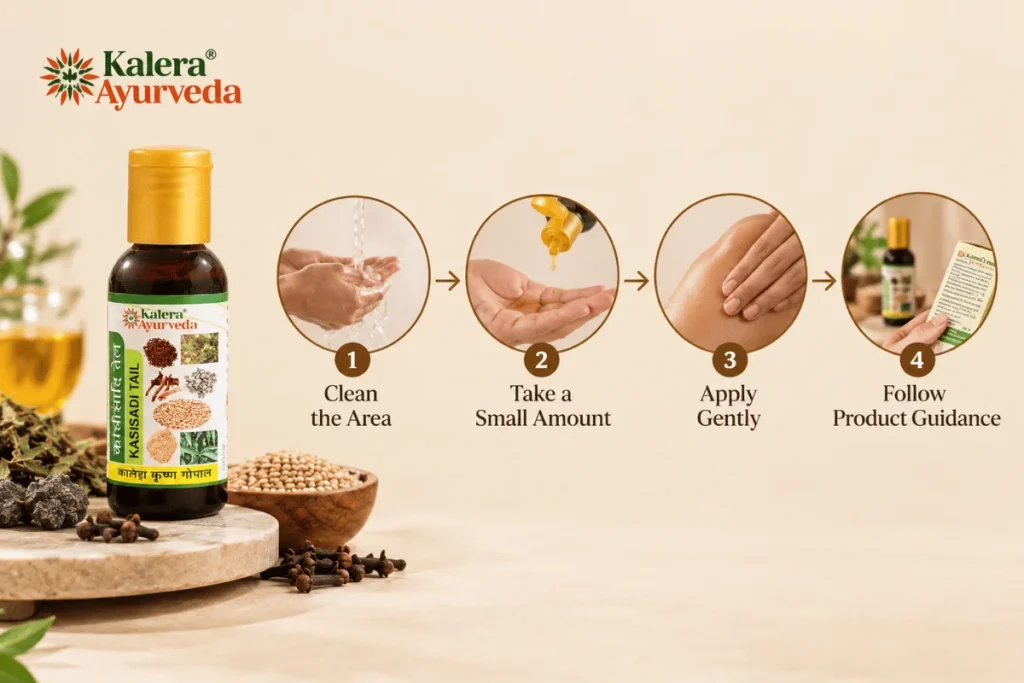
For Kalera Kasisadi Tail, the current product instructions state:
- Apply a small quantity to the desired area.
- Massage gently.
- It may be used around 2–3 times daily or as advised by an Ayurvedic wellness professional.
- A warm compress may optionally be used after application.
- Store in a cool, dry place away from direct sunlight and moisture.
- The product is intended for external use.
Important: External Application vs Clinical Procedures
Some published studies use Kasisadi Taila through rectal instillation or other clinical procedures. Those protocols should not be confused with normal home application.
Do not attempt to insert an oil into the rectum or use invasive application methods without direct guidance from a qualified healthcare professional.
Kasisadi Tail vs Jatyadi Tail
Both are Ayurvedic external oil preparations, but their traditional uses are not identical.
| Feature | Kasisadi Tail | Jatyadi Tail |
|---|---|---|
| Form | Medicated Ayurvedic oil | Medicated Ayurvedic oil |
| Traditional discussion | Arsha, local anorectal care and certain topical uses | Wound and external skin care |
| Main application | Depends on formulation | External/local application |
| Suitable for | Depends on specific formulation and purpose | Depends on specific formulation and purpose |
| Self-treatment | Should be approached cautiously | Should follow product/practitioner guidance |
A clinical comparison between Kasisadi Taila and Jatyadi Taila has been published in the context of Arsha, but the study protocols should not be interpreted as general instructions for home use.
Who Should Be Careful With Kasisadi Tail?
Kasisadi Tail is not an ordinary cosmetic oil. Some classical formulations contain mineral ingredients and potent herbal substances, so appropriate product identification and professional guidance are important.
Extra caution is advisable if:
- You have unexplained rectal bleeding.
- You have severe or persistent anal pain.
- You have a deep or infected wound.
- You are pregnant or breastfeeding.
- You have a diagnosed chronic condition.
- You are already using other topical or Ayurvedic medicines.
- You are unsure whether the product is intended for external application or another clinical procedure.
Do not apply it to the eyes or sensitive areas unless specifically directed for that use.
If bleeding, pain, swelling or another symptom persists, seek medical evaluation instead of continuing self-treatment.
Frequently Asked Questions About Kasisadi Tail
1. What are the main Kasisadi Tail benefits?
Kasisadi Tail is traditionally associated with localized external care, particularly in Ayurvedic discussions of piles, fissure-related care and certain skin or tissue concerns. However, benefits depend on the exact formulation and method of application.
2. Is Kasisadi Tail used for piles?
Yes, Kasisadi Taila has a long traditional association with Arsha (hemorrhoids), and clinical studies have evaluated specific Kasisadi preparations in first- and second-degree hemorrhoids. However, research protocols may involve clinical administration and additional treatments, so they should not be copied as home-treatment instructions.
3. Can Kasisadi Tail be used for fissures?
Kasisadi Taila has been investigated in Ayurvedic clinical studies and case reports involving fissure-in-ano. However, some studies used specific rectal administration protocols under clinical supervision. Therefore, people should not independently insert the oil without professional guidance.
4. How should Kasisadi Tail be applied?
For Kalera’s current Kasisadi Tail, the product page recommends applying a small quantity externally and massaging gently over the desired area. It should be used according to the product instructions because different Kasisadi formulations may have different intended applications.
5. Can Kasisadi Tail be used every day?
Kalera currently states that its Kasisadi Tail is typically used 2–3 times daily or as advised by an Ayurvedic wellness professional. However, frequency should not be generalized to every Kasisadi Tail product.
6. Does Kasisadi Tail treat piles permanently?
There is not enough evidence to describe Kasisadi Tail as a guaranteed permanent cure for piles. Some clinical studies report improvements in specific symptoms, but they involved particular formulations and treatment protocols. Persistent or recurrent bleeding and pain should be medically evaluated.
Final Takeaway
Kasisadi Tail is a traditional Ayurvedic medicated oil whose uses vary according to its exact formulation and method of application. The strongest search and research interest around classical Kasisadi Taila relates to piles and other anorectal conditions, while Kalera Ayurveda’s current formulation is positioned primarily as an external massage oil for muscle, joint and local comfort.
Clinical research on specific Kasisadi Taila preparations has reported improvements in selected hemorrhoid and fissure-related outcomes, but the evidence remains limited and should not be generalized to every product on the market.
The safest approach is to check the exact product formulation, follow its stated directions and seek qualified medical or Ayurvedic guidance for persistent pain, bleeding, fissures, piles or other medical conditions.