
Kumkumadi Tail for Skin Glow: An Ayurvedic Approach to Skin Care
Kumkumadi Tail for Skin Glow is traditionally used as a facial oil to support natural radiance, nourishment and an even-looking complexion. Unlike a simple carrier oil, Kumkumadi Tail is a multi-herb Ayurvedic preparation traditionally made with saffron and several botanical ingredients.
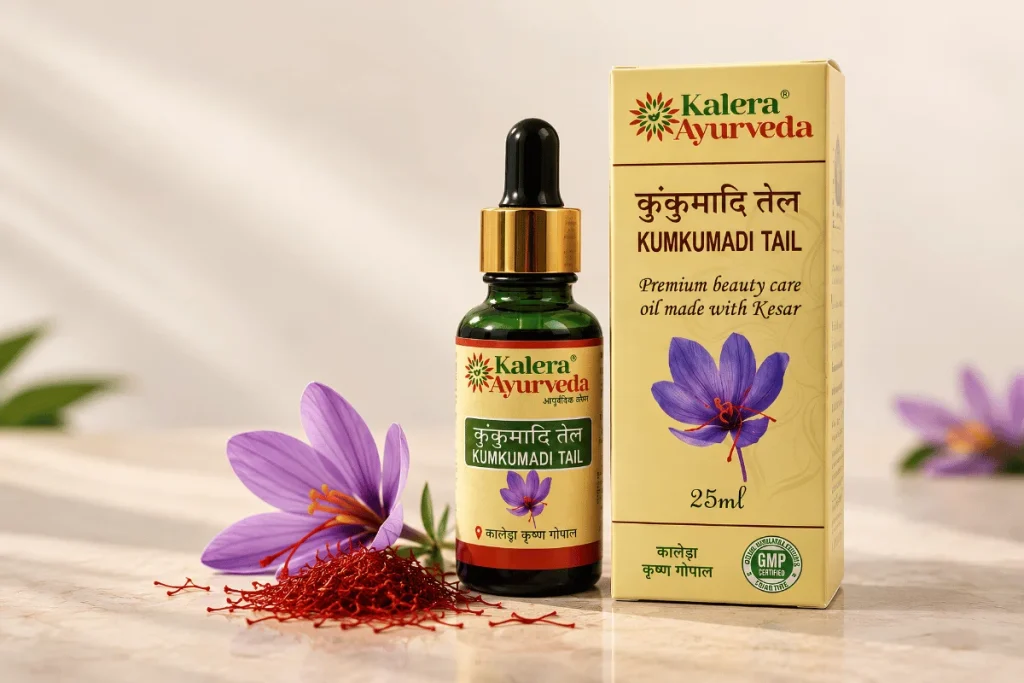
Kalera Ayurveda’s Kumkumadi Tail contains Kesar, Manjistha, Yashtimadhu, Chandana, Padmaka, Nilkamal, Lodhra, Daruharidra, Haldi and sesame oil. The current product page positions the formulation around skin glow, pigmentation, uneven tone, smooth texture and nourishment.
The important thing is to understand Kumkumadi Tail as a traditional skincare formulation, rather than as a guaranteed treatment for pigmentation, acne, scars or other skin conditions.
What Is Kumkumadi Tail?
Kumkumadi Tail, also called Kumkumadi Tailam, is a classical Ayurvedic oil formulation used externally for skin care. Saffron is one of its characteristic ingredients, while other herbs are traditionally combined to create a broader complexion-focused formulation.
Different manufacturers can have variations in their formulations. Therefore, it is always better to check the ingredient list of the specific product rather than assuming that every Kumkumadi Tail contains exactly the same herbs.
Key Ingredients in Kalera Kumkumadi Tail
| Ingredient | Traditional skincare relevance |
|---|---|
| Kesar (Saffron) | Traditionally associated with complexion and natural radiance |
| Manjistha | Traditionally used in Ayurvedic skin formulations |
| Yashtimadhu | Traditionally valued for soothing and complexion care |
| Chandana | Traditionally associated with cooling and soothing properties |
| Padmaka | Traditionally used in complexion-focused preparations |
| Nilkamal | Traditionally associated with skin nourishment |
| Lodhra | Traditionally used in skin and complexion formulations |
| Daruharidra | Traditionally included in skin-supportive preparations |
| Haldi | Traditionally valued for its botanical and antioxidant properties |
| Til Tail (Sesame Oil) | Provides the nourishing oil base |
Kalera’s current product information confirms these ingredients and describes the formulation as an Ayurvedic beauty oil for external skincare.
For readers interested in other traditional oils, Kalera’s Ayurvedic Oil collection includes formulations designed for different traditional skincare and wellness purposes.
7 Kumkumadi Tail Benefits for Skin
1. Supports Natural Skin Glow
The most popular reason people search for Kumkumadi Tail is its traditional association with skin glow.
The combination of saffron and other botanical ingredients is used in Ayurvedic skincare routines to support a healthy-looking and naturally radiant complexion. The oil also provides nourishment through its sesame-oil base.
A realistic expectation is better-looking, nourished skin, rather than a permanent change in natural skin colour.
2. Supports an Even-Looking Skin Tone
Uneven skin tone can develop for many reasons, including sun exposure, dryness and post-inflammatory changes.
Kumkumadi Tail is traditionally used for complexion care, and Kalera Ayurveda specifically describes its formulation as supporting an even skin tone and helping with the appearance of dark spots and pigmentation.
However, pigmentation can have different underlying causes. If dark patches persist, increase suddenly or change in appearance, professional dermatological evaluation is more appropriate than relying only on a facial oil.
3. Nourishes Dry and Dull-Looking Skin
A facial oil can provide an additional layer of nourishment for skin that feels dry or lacks softness.
The sesame-oil base in Kumkumadi Tail, together with the botanical ingredients, makes it suitable for people who prefer oil-based skincare. Applying a small amount and massaging gently can leave the skin feeling conditioned and comfortable.
For people who also want to explore traditional hair and scalp oils, Kalera’s Bhringraj Oil is a separate formulation intended for scalp and hair care rather than facial use.
4. Helps Improve the Appearance of Dull Skin
Environmental exposure, dryness, inadequate sleep and an inconsistent skincare routine can all contribute to a dull appearance.
Kumkumadi Tail can be incorporated into a simple evening routine to provide botanical nourishment and facial massage. The traditional formulation is designed around complexion care rather than aggressive exfoliation.
Regular skincare habits still matter more than any single product. Gentle cleansing, hydration and sun protection should remain part of the routine.
5. Supports Softer-Looking Skin
Well-nourished skin generally feels smoother and more comfortable.
Kumkumadi Tail’s oil base can help condition the skin’s surface, while the herbal ingredients provide the traditional Ayurvedic character of the formulation.
This makes it particularly relevant for people who prefer a richer nighttime facial-care product rather than a lightweight water-based serum.
6. Provides Botanical Antioxidant Support
Several herbs used in traditional complexion formulations have been investigated for antioxidant and skin-related properties.
A review of Ayurvedic Varṇya herbs discusses ingredients found in traditional complexion preparations, including herbs such as liquorice, sandalwood and those associated with Kumkumadi Taila. Laboratory evidence for individual herbs is interesting, but it should not be treated as proof that the complete oil will produce a specific clinical result.
This is why Kumkumadi Tail is better described as a traditional botanical skincare preparation rather than a clinically proven treatment for pigmentation or ageing.
7. Fits Into a Traditional Ayurvedic Skincare Routine
Kumkumadi Tail offers a simple way to include a traditional Ayurvedic oil in a modern skincare routine.
It can be used as a facial massage oil or as a nighttime leave-on oil, depending on the product directions and individual skin tolerance. Kalera currently recommends applying a few drops to a clean face, massaging gently and using it once or twice daily, preferably at night.
How to Apply Kumkumadi Tail on the Face
Correct application is important because using too much facial oil does not necessarily provide better results.
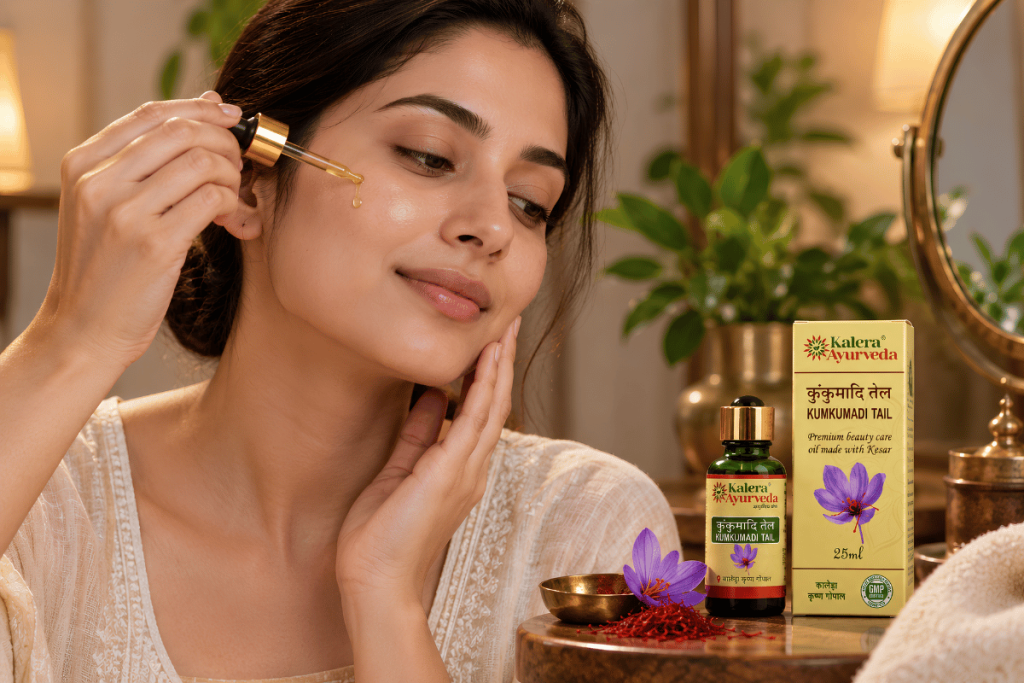
For Kalera Kumkumadi Tail, the current product instructions recommend applying a few drops to a clean face and gently massaging in circular motions. It can be used once or twice daily, preferably at night, and may be left on for around 30 minutes to overnight.
Simple Application Routine
Step 1: Clean your face with a gentle cleanser.
Step 2: Pat the skin dry without rubbing.
Step 3: Take a few drops of Kumkumadi Tail on your fingertips.
Step 4: Apply evenly over the face and neck.
Step 5: Massage gently using small circular movements.
Step 6: Leave it on according to your skin’s tolerance and the product instructions.
If you are using Kumkumadi Tail for the first time, nighttime application is a practical way to introduce it into your routine.
When Is the Best Time to Use Kumkumadi Tail?
For Kalera Kumkumadi Tail, nighttime use is recommended on the current product page. The oil can be applied after cleansing and gently massaged into the skin.
Nighttime application is also convenient because the oil can remain on the skin without interfering with makeup or other daytime products.
If you use Kumkumadi Tail during the day, remember that it does not replace sunscreen. Daily sun protection is especially important if your main concern is pigmentation or uneven skin tone.
Is Kumkumadi Tail Suitable for Every Skin Type?
Not necessarily.
Every person’s skin can react differently to an oil-based formulation. Someone with dry skin may find a facial oil comfortable, while someone with oily or acne-prone skin may prefer a smaller amount or less frequent application.
Kalera Ayurveda recommends a patch test before first use and states that its Kumkumadi Tail is for external use only. The product page also advises consultation with a healthcare provider during pregnancy, breastfeeding or medical supervision.
If you experience persistent burning, redness, itching, swelling or worsening breakouts, discontinue use and seek appropriate professional advice.
Those interested in exploring other traditional Ayurvedic oil preparations can also read about Anu Tail, which has a different traditional application from Kumkumadi Tail.
Kumkumadi Tail for Pigmentation and Dark Spots: What to Expect
Pigmentation is one of the major reasons people search for Kumkumadi Tail.
Traditional Ayurvedic skincare commonly includes Kumkumadi-based formulations for complexion and pigmentation-related concerns. Kalera’s product page also describes the oil as supporting the appearance of dark spots and uneven skin tone.
However, pigmentation is not one single condition. It can be associated with sun exposure, acne marks, hormonal changes, irritation and several dermatological conditions.
Therefore, Kumkumadi Tail may be used as supportive skincare, but it should not be presented as a universal solution for every type of pigmentation.
If pigmentation is persistent or worsening, identifying its cause is more important than simply changing facial oils.
What Does Research Say About Kumkumadi Tail?
There is limited clinical research specifically on Kumkumadi Taila, but one comparative clinical study evaluated its traditional Varnya (complexion-supporting) effect against different cream preparations. The study included 60 participants across four groups and reported better results with Kumkumadi Taila than the cream preparations used in that study. However, the study was relatively small, so these findings should be interpreted as preliminary rather than as proof that Kumkumadi Tail treats pigmentation or other skin conditions. You can read the full clinical study on Kumkumadi Taila for details about its methodology and findings.
Scientific research on Kumkumadi Tail itself is still limited, but there is research on traditional Ayurvedic complexion formulations and their individual botanical ingredients.
A published review examined Ayurvedic Varṇya herbs used traditionally for maintaining and improving skin appearance. It discussed ingredients including liquorice, sandalwood and formulations such as Kumkumadi Taila, while also examining laboratory evidence related to pigmentation and tyrosinase activity.
The findings are useful for understanding why certain herbs are traditionally included in complexion formulations, but laboratory findings on individual ingredients cannot automatically establish that a finished commercial oil will treat pigmentation, acne or other skin disorders.
For that reason, Kumkumadi Tail should be considered a traditional Ayurvedic skincare product, with realistic expectations about what a facial oil can and cannot do.
Kumkumadi Tail vs Regular Face Oil
Kumkumadi Tail and ordinary facial oils may both be used for moisturising and skin conditioning, but their formulation approach is different.
| Feature | Kumkumadi Tail | Regular Face Oil |
|---|---|---|
| Formulation | Multi-herb Ayurvedic preparation | Usually one or several cosmetic oils |
| Traditional purpose | Complexion, nourishment and radiance | Mainly moisturising/conditioning |
| Key ingredients | Saffron plus several herbs | Depends on the product |
| Application | Usually facial massage or leave-on care | Depends on the oil |
| Skincare approach | Traditional Ayurvedic | Cosmetic skincare |
The right choice depends on your skin type, routine and the ingredients you tolerate well.
Ayurvedic oils are formulated for different purposes. For example, Jatyadi Tail is intended for a different type of traditional external application and should not be used as a substitute for a facial oil.

FAQs : About Kumkumadi Tail
1. Is Kumkumadi Tail good for skin glow?
Kumkumadi Tail is traditionally used to support natural radiance, nourishment and an even-looking complexion. Its saffron and herbal ingredients are commonly associated with Ayurvedic beauty care. Results can vary between individuals, so it is better to expect healthier-looking and nourished skin rather than a permanent change in skin colour.
2. Can Kumkumadi Tail reduce pigmentation?
Kumkumadi Tail is traditionally used for complexion and pigmentation-related skincare, and Kalera positions its product for dark spots and uneven skin tone. However, pigmentation can have many causes. A facial oil should therefore be viewed as supportive skincare rather than a guaranteed treatment for pigmentation.
3. Can I use Kumkumadi Tail every day?
Kalera Ayurveda currently recommends using its Kumkumadi Tail once or twice daily, preferably at night. If you are using it for the first time, starting with a small amount once at night can help you understand how your skin responds.
4. How many drops of Kumkumadi Tail should I use?
A few drops are generally enough for facial application. Kalera recommends applying a few drops to a clean face and gently massaging in circular motions. Using a very large quantity is unnecessary and may feel heavy, particularly on oily or combination skin.
5. Can Kumkumadi Tail be used on acne-prone skin?
People with acne-prone skin should introduce any facial oil carefully because individual responses can differ. Perform a patch test first and start with a small amount. If you notice increased breakouts or irritation, discontinue use and consider professional skincare advice.
6. Can I use Kumkumadi Tail during the day?
Yes, it can be used according to the product directions, but Kalera recommends nighttime application. If you use it during the day, continue using a suitable broad-spectrum sunscreen because Kumkumadi Tail is not a substitute for sun protection.
Final Takeaway
Kumkumadi Tail is a traditional Ayurvedic facial oil designed around saffron and multiple botanical ingredients. Its traditional skincare uses focus on natural radiance, nourishment, smooth-looking skin and an even-looking complexion.
Kalera Ayurveda’s formulation combines Kesar, Manjistha, Yashtimadhu, Chandana, Padmaka, Nilkamal, Lodhra, Daruharidra, Haldi and sesame oil.
For someone looking to add an Ayurvedic facial oil to a skincare routine, Kumkumadi Tail can be considered a supportive option. But realistic expectations are important: it should not be presented as a cure for pigmentation, acne, scars or other skin diseases.
A consistent skincare routine, daily sun protection, suitable nutrition and attention to the underlying cause of skin concerns remain important for long-term skin health.