
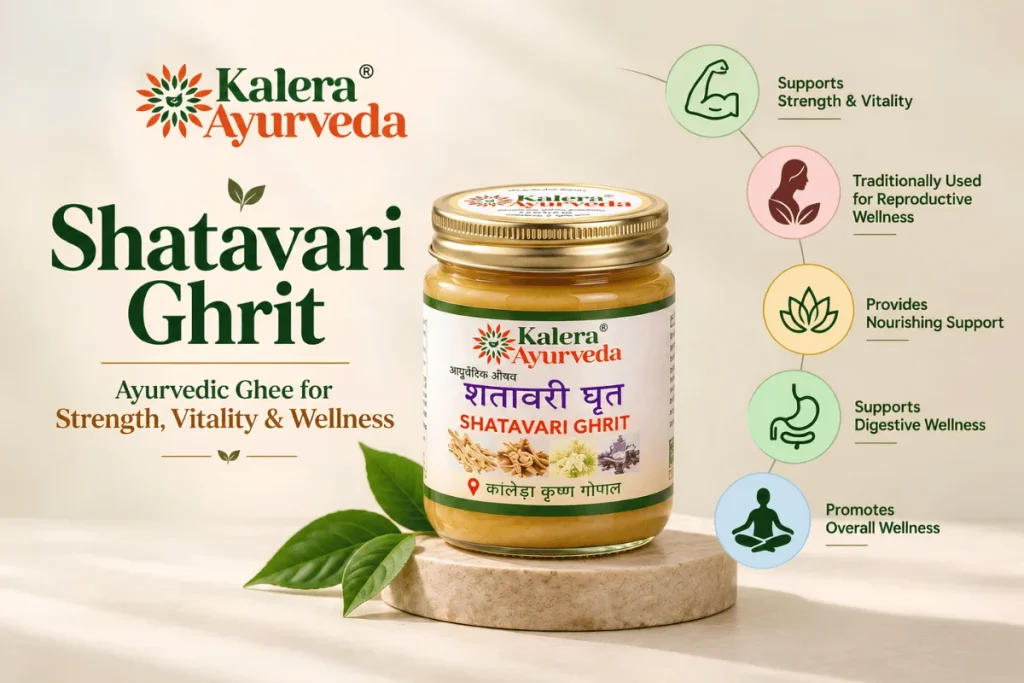
Shatavari Ghrit Benefits: Understanding This Ayurvedic Formulation
Shatavari Ghrit benefits are traditionally associated with nourishment, strength, vitality and overall wellness. Shatavari (Asparagus racemosus) is one of the well-known herbs used in Ayurveda, while Ghrit refers to a ghee-based herbal preparation. When these are combined with complementary herbs, the result is a nourishing formulation traditionally used as part of a balanced Ayurvedic routine.
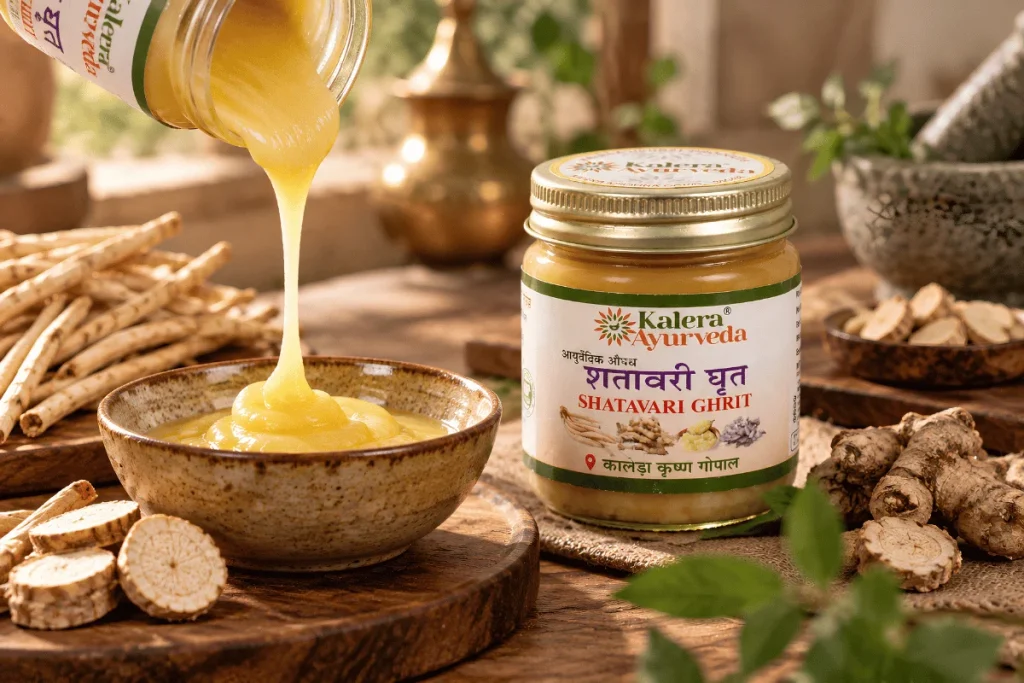
Kalera Ayurveda’s Shatavari Ghrit contains Shatavari along with Ashwagandha, Vidari Kanda, Jivanti, Mulethi and ghee. The product is traditionally positioned around reproductive wellness, vitality, digestive support and general wellbeing.
However, Shatavari Ghrit should not be viewed as a medicine for one particular disease. Its traditional use is broader, with emphasis on nourishment and maintaining strength and balance.
What Is Shatavari Ghrit?
Shatavari Ghrit is an Ayurvedic ghee preparation made by combining Shatavari with ghee and other supportive herbs. In Ayurvedic practice, Ghrit preparations are valued because they provide a nourishing base for herbal ingredients and are traditionally incorporated into specific wellness routines.
Shatavari is the central herb in this formulation. It is traditionally described as nourishing and supportive of vitality, while the additional ingredients give the formulation a broader wellness profile.
Key Ingredients in Shatavari Ghrit
Kalera Ayurveda’s formulation includes:
| Ingredient | Traditional role |
|---|---|
| Shatavari | Traditionally valued for nourishment, vitality and reproductive wellness |
| Ashwagandha | Traditionally associated with strength, energy and resilience |
| Vidari Kanda | Traditionally used for nourishing and supportive properties |
| Jivanti | Traditionally associated with rejuvenative wellness |
| Mulethi | Traditionally used in various Ayurvedic formulations for its soothing and balancing qualities |
| Ghee | The nourishing base of the Ghrit preparation |
The combination is important because the formulation should be considered as a whole rather than assuming that every traditional use of Shatavari alone automatically applies to the finished Ghrit.
For readers exploring other Ayurvedic ghee preparations, the Ghrit collection includes formulations designed around different traditional wellness goals.
Explore Kalera Ayurveda’s Ghrit Collection
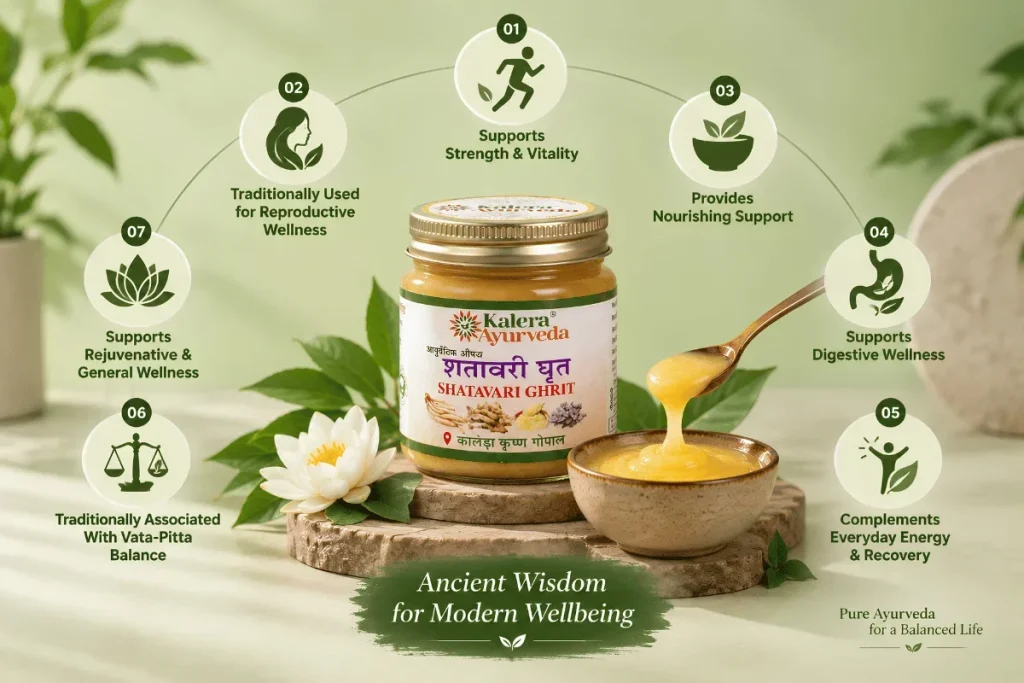
7 Shatavari Ghrit Benefits and Traditional Uses
1. Supports Strength and Vitality
One of the main reasons nourishing Ayurvedic formulations are included in wellness routines is to support strength and vitality.
Shatavari is traditionally considered a nourishing herb, while Ashwagandha and Vidari Kanda add to the formulation’s traditional restorative profile. Shatavari Ghrit can therefore be considered as part of a routine focused on maintaining energy and physical wellbeing.
It is better viewed as a nourishing support rather than something expected to provide an immediate stimulant-like energy boost.
2. Traditionally Used for Reproductive Wellness
Shatavari has a long-standing place in Ayurveda in relation to reproductive wellness. This is also one of the strongest themes visible in current search results for Shatavari Ghrit.
Modern research has mainly studied Shatavari root extracts, rather than every Shatavari Ghrit formulation. Recent randomized trials have reported improvements in selected menopausal symptoms with standardized Shatavari extracts, although these findings should not be directly treated as proof that an oral Shatavari Ghrit product produces identical results.
Therefore, Shatavari Ghrit can reasonably be described as a traditional wellness formulation associated with reproductive support, but not as a guaranteed treatment for infertility, hormonal disorders or other medical conditions.
3. Provides Nourishing Support
The ghee base gives Shatavari Ghrit its characteristic nourishing nature. In Ayurveda, Ghrit preparations are traditionally used when nourishment and replenishment are important considerations.
This makes the formulation relevant to people looking for a herbal preparation that fits into a broader wellness routine involving adequate food, rest and healthy daily habits.
The purpose is not to replace a balanced diet. Instead, it can be considered one component of a traditional approach to nourishment.
4. Supports Digestive Wellness
Kalera’s Shatavari Ghrit is also traditionally positioned for digestive support. The formulation combines its herbal ingredients with ghee and is traditionally taken with warm milk or water.
However, digestive support should not be confused with treatment for conditions such as ulcers, severe acidity or chronic digestive disorders. Persistent symptoms should be evaluated to determine their underlying cause.
For a more specifically digestive-oriented Ayurvedic Ghrit, Kalera’s Triphala Ghrit has a different formulation containing Triphala, ghee and other herbs and is traditionally positioned around digestion and regularity.
5. Complements Everyday Energy and Recovery
Daily work, physical activity, irregular meals and inadequate rest can all affect how energetic a person feels. A nourishing formulation such as Shatavari Ghrit may be incorporated into an Ayurvedic wellness routine when the goal is maintaining vitality rather than seeking a quick energy product.
Its traditional profile is more closely associated with nourishment and balance than with an instant performance effect.
6. Traditionally Associated With Vata-Pitta Balance
Within Ayurvedic principles, Shatavari is traditionally considered a nourishing herb with cooling qualities and is commonly discussed in relation to Vata and Pitta balance.
This traditional perspective is one reason Shatavari appears in formulations intended for nourishment and restorative wellness.
Dosha-based recommendations are individualized, however. The same preparation may not be appropriate in exactly the same way for every person, particularly when digestive capacity, diet and other health factors differ.
7. Supports Rejuvenative and General Wellness
Shatavari is traditionally regarded as a Rasayana herb, a category associated with nourishment, rejuvenation and maintaining vitality.
Shatavari Ghrit brings this traditional concept into a ghee-based preparation. Its role is therefore better understood as supportive daily wellness, rather than a standalone treatment.
For a different type of rejuvenative Ayurvedic formulation, Brahma Rasayan is traditionally positioned around strength, vitality and general rejuvenative wellness.
How to Take Shatavari Ghrit?
The correct dosage of Shatavari Ghrit depends on the particular formulation, individual requirements and professional advice.
For Kalera Shatavari Ghrit, the product guidance recommends referring to the packaging for dosage or consulting a qualified Ayurvedic practitioner. It is traditionally taken with warm milk or water.
A few practical points are important:
- Follow the dosage mentioned on the product packaging.
- Do not increase the quantity simply because the product contains herbs.
- Take it as part of a balanced dietary and lifestyle routine.
- If you are already taking medicines or other herbal formulations, discuss its use with a healthcare professional.
- Store the product in a cool, dry place away from direct sunlight. Kalera recommends using it within 12 months of manufacture.
What Is the Best Time to Take Shatavari Ghrit?
There is no single timing that is ideal for every individual. The appropriate time can depend on the formulation, diet, digestion and the reason for using it.
Since Kalera recommends taking its Shatavari Ghrit with warm milk or water and following the product’s dosage guidance, it is better to follow the manufacturer’s directions rather than applying a generic dosage or timing rule.
Shatavari Ghrit and Modern Research: What Does the Evidence Say?
Interest in Shatavari has increased in recent clinical research, particularly around reproductive and menopausal wellness.
A 2025 randomized, double-blind, placebo-controlled study involving 80 women evaluated an oral Shatavari root extract for perimenopausal symptoms over eight weeks. The researchers reported improvements in several symptom measures and stress scores, while safety markers for liver and kidney function did not show concerning changes during the study period. Importantly, the study used a specific Shatavari root extract, not Shatavari Ghrit.
Another 2025 randomized study involving 135 women compared Shatavari root extract, Shatavari combined with Ashwagandha, and placebo for menopausal symptoms. The results showed improvements in selected measures, although the researchers also noted the need for longer and larger studies.
These findings are useful when understanding the potential of Shatavari as an herb, but they should not be used to claim that every Shatavari-containing formulation has the same clinical effect.
This distinction is important because the formulation, extraction method, dosage and intended use can all influence research outcomes.
Is Shatavari Ghrit Safe for Everyone?
Herbal does not automatically mean suitable for everyone. Individual tolerance can vary depending on the formulation, dosage, existing health conditions and other medicines or supplements being used.
People who are pregnant or breastfeeding, managing a chronic health condition, taking regular medication or using multiple herbal products should seek professional advice before starting a new Ayurvedic preparation.
For general information about the evidence and safety considerations surrounding Ayurvedic medicine, see the NCCIH overview of Ayurvedic medicine.
NCCIH Overview of Ayurvedic Medicine
If a person develops unusual or persistent symptoms after using an herbal product, it is sensible to stop and seek appropriate medical guidance rather than continuing without evaluation.
Shatavari Ghrit vs Other Ayurvedic Ghrit Preparations
Ayurvedic Ghrit formulations are not interchangeable. Their ingredients and traditional purposes can differ considerably.
| Ghrit | Traditional wellness focus |
|---|---|
| Shatavari Ghrit | Nourishment, vitality and reproductive wellness |
| Brahmi Ghrit | Memory, focus and mental wellness |
| Triphala Ghrit | Digestive wellness and regularity |
| Panchtikta Ghrit | Traditionally associated with skin and dosha-focused wellness |
| Fal Ghrit | Traditional nourishment, vitality and reproductive wellness |
For readers interested in mental wellness and concentration, Brahmi Ghrit provides a different herbal profile and traditional purpose.
The important point is that choosing a Ghrit should depend on the intended wellness goal rather than simply selecting one because it contains ghee or because another formulation has more commonly discussed benefits.
Frequently Asked Questions About Shatavari Ghrit
1. What are the main Shatavari Ghrit benefits?
Shatavari Ghrit is traditionally used as a nourishing Ayurvedic ghee preparation associated with strength, vitality, reproductive wellness and general wellbeing. Its actual suitability depends on the individual, the formulation and the reason for use.
2. What is Shatavari Ghrit used for?
Traditionally, Shatavari Ghrit is used to support nourishment, vitality and reproductive wellness. It may also be included in Ayurvedic routines focused on maintaining strength and overall balance. It should not be presented as a guaranteed treatment for a particular disease.
3. What is the best time to take Shatavari Ghrit?
There is no universal best time for everyone. For Kalera Shatavari Ghrit, the product guidance recommends following the dosage instructions on the packaging or consulting a qualified Ayurvedic practitioner. It can traditionally be taken with warm milk or water.
4. Can Shatavari Ghrit be taken with milk?
Yes. Kalera Ayurveda states that its Shatavari Ghrit is traditionally taken with warm milk or water. However, people who do not tolerate dairy or who follow a specific dietary plan should choose the accompanying liquid accordingly and seek professional advice when needed.
5. Is Shatavari Ghrit suitable for men?
Shatavari is often discussed in relation to reproductive and women’s wellness, but the herb itself is not exclusively relevant to women. Shatavari Ghrit may be considered in a broader nourishment and vitality context, but suitability for men should depend on the individual’s needs and the specific formulation rather than on a general assumption.
6. Does Shatavari Ghrit have side effects?
Tolerance can vary between individuals. Because Shatavari Ghrit is a multi-ingredient ghee-based formulation, some people may not tolerate it well or may experience digestive discomfort. Anyone taking medicines, managing a health condition, or considering use during pregnancy or breastfeeding should seek professional advice before using it.
Final Thoughts
Shatavari Ghrit is best understood as a traditional Ayurvedic nourishing formulation for strength, vitality and overall wellness. Shatavari forms the foundation of the preparation, while ingredients such as Ashwagandha, Vidari Kanda, Jivanti, Mulethi and ghee contribute to its broader traditional profile.
Current research on Shatavari is encouraging in selected areas, particularly around menopausal and reproductive wellness, but most modern clinical evidence relates to specific Shatavari extracts or formulations, not necessarily to every Shatavari Ghrit product.
The most sensible approach is therefore to use Shatavari Ghrit as part of a balanced wellness routine, follow the product’s recommended usage and seek professional guidance when there are existing health conditions, medicines or special circumstances.