

Finding the best Ayurvedic hair oil for hair fall can be confusing when every bottle seems to promise stronger roots, thicker hair and better growth. The better approach is to look beyond marketing claims and understand the ingredients, your scalp condition and the type of hair fall you are experiencing.
Ayurvedic hair oils commonly use herbs such as Bhringraj, Amla, Brahmi and Neem, often prepared in a carrier oil such as coconut or sesame oil. These ingredients have long-standing traditional use in Ayurvedic hair care, although the strength of modern evidence differs from herb to herb.
It is also important to remember that hair fall can have many causes. Hereditary hair loss, nutritional deficiencies, hormonal changes, illness, stress, scalp conditions and damaging hair-care practices can all contribute. The American Academy of Dermatology recommends identifying the underlying cause rather than relying only on a cosmetic or home-care product.
What Makes an Ayurvedic Hair Oil Suitable for Hair Fall?
A good hair oil should fit your actual hair and scalp needs rather than simply containing many herbs.
When comparing Ayurvedic hair oils, consider:
- The main herbal ingredients
- The carrier oil used
- Whether the formulation suits your scalp
- How often you can realistically use it
- Whether the product is intended for scalp application
- Whether the brand clearly lists its ingredients and directions
For example, Bhringraj is one of the most commonly discussed Ayurvedic herbs for hair care. Modern research around Bhringraj and hair growth is promising but still largely preclinical, so it is better to describe it as supporting a healthy hair-care routine rather than guaranteeing regrowth.

7 Things to Look for in the Best Ayurvedic Hair Oil for Hair Fall
1. Bhringraj as a Key Ingredient
Bhringraj, traditionally identified with Eclipta species, is often called the “King of Hair” in Ayurvedic hair-care traditions. It is widely used in herbal hair oils intended for scalp and hair nourishment.
Current competitor content also places Bhringraj prominently among Ayurvedic oils for hair growth and hair fall.
If your main concern is thinning, weak-looking hair or maintaining a regular scalp-oiling routine, a Bhringraj-based formulation can be a practical option.
For example, Kalera Ayurveda’s Bhringraj Oil uses Bhringraj along with Amla, Brahmi, Neem and Coconut Oil.
2. Amla for Hair and Scalp Nourishment
Amla is another familiar ingredient in Ayurvedic hair formulations. It is traditionally used for maintaining hair strength, shine and overall scalp care.
Several current products and competitor guides combine Amla with Bhringraj, rather than relying on a single herb. Indulekha, for example, lists Bhringraj, Amla, Svetakutaja and virgin coconut oil in its Bringha Oil formulation.
For people who already include Amla-based Ayurvedic products in their routine, Kalera’s Amalki Rasayan can also be explored as a separate Ayurvedic product rather than replacing the external hair-oiling routine.
3. Brahmi for a Balanced Scalp-Care Routine
Brahmi is traditionally valued in Ayurveda and is frequently included in herbal formulations designed for overall scalp and hair care.
It is worth remembering that adding more herbs does not automatically make an oil better. What matters is whether the formulation is appropriate for your scalp and whether you can use it consistently.
If you are interested in Brahmi-based Ayurvedic formulations, Brahmi Ghrit is another Kalera product, but it should not be confused with a topical hair oil.
4. A Suitable Carrier Oil
The herbal ingredients get most of the attention, but the base oil also matters.
Coconut oil, for example, has evidence from hair-fibre research showing that it can reduce protein loss from hair, which is relevant to maintaining the condition of the hair shaft. This is different from proving that coconut oil itself treats every cause of hair loss.
A traditional Ayurvedic hair oil may use coconut, sesame or another suitable base depending on its formulation.
5. A Formula That Matches Your Scalp
The same oil may not feel equally comfortable on every scalp.
If your scalp tends to feel dry, you may prefer a nourishing oiling routine. If your scalp becomes oily quickly or you experience buildup, using a large quantity of oil may be uncomfortable.
For this reason, “more oil” does not necessarily mean “better results.”
Start with a moderate amount and adjust according to your hair length, scalp condition and washing routine.
6. Clear Usage Instructions
A quality hair oil should have clear directions.
For example, Kalera’s Bhringraj Oil page recommends applying the oil to the scalp, gently massaging it, leaving it for around 1–2 hours or overnight, and using it 2–3 times a week.
Other products may recommend different schedules. Indulekha, for instance, recommends its Bringha Oil three times weekly for four months, with the oil left on for 3–4 hours before washing.
This shows why you should follow the directions of the particular formulation rather than assuming every Ayurvedic hair oil should be used in exactly the same way.
7. A Realistic Approach to Hair Fall
Perhaps the most important point is to avoid expecting an oil to solve every type of hair loss.
Hair shedding can happen after illness, major stress, childbirth or other physical changes. Hereditary hair loss, hormonal conditions, nutritional deficiencies, scalp infections and certain medications can also cause hair loss.
An Ayurvedic hair oil can be part of a consistent hair-care routine, but persistent or sudden hair loss deserves proper evaluation.
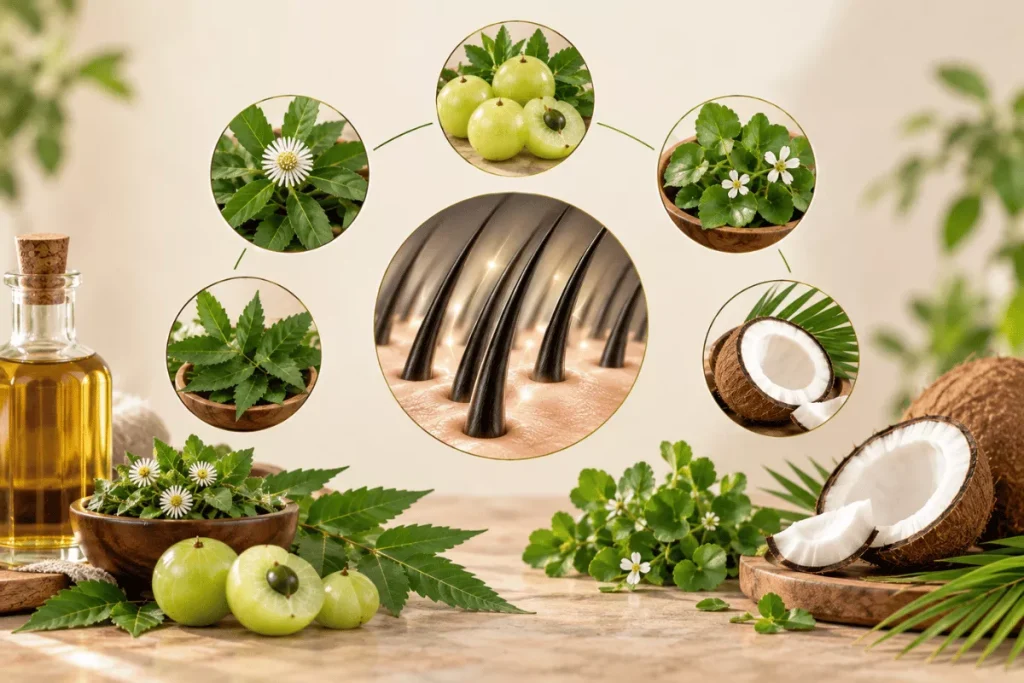
Which Ayurvedic Ingredients Are Commonly Used for Hair Fall?
Here is a simple comparison:
| Ingredient | Traditional hair-care role | Best suited to |
|---|---|---|
| Bhringraj | Hair and scalp nourishment | Regular scalp-care routines |
| Amla | Supports hair strength and shine | Dull or weak-looking hair |
| Brahmi | Traditional scalp-care ingredient | General scalp nourishment |
| Neem | Traditionally used for scalp cleansing | Scalp-care routines |
| Coconut Oil | Conditions and protects the hair shaft | Dry or damaged hair |
| Sesame Oil | Traditional Ayurvedic carrier oil | Classical oiling routines |
The presence of an ingredient should not be treated as proof that the finished product will regrow hair. Different formulations, concentrations and preparation methods can produce different results.
Is Bhringraj Oil the Best Ayurvedic Hair Oil for Hair Fall?
Bhringraj is certainly one of the most relevant ingredients to consider when looking for an Ayurvedic hair oil for hair fall.
Research reviewed by modern sources suggests that Bhringraj has direct hair-growth-related preclinical evidence, but large, high-quality human trials are still limited.
So a more accurate statement is:
Bhringraj oil can be a useful part of an Ayurvedic hair-care routine, but it should not be presented as a guaranteed treatment for hair loss.
For someone looking for a Bhringraj-focused option, Kalera Bhringraj Oil contains Bhringraj along with Amla, Brahmi, Neem and Coconut Oil.
Best Ayurvedic Hair Oil for Hair Fall: Bhringraj vs Amla vs Coconut Oil
Choosing between these ingredients depends on your goal.
Bhringraj: A good choice when you specifically want a traditional Ayurvedic hair-care ingredient associated with scalp and hair nourishment.
Amla: Useful when your focus is overall hair conditioning, strength and shine.
Coconut oil: Particularly useful when dryness, roughness and hair-shaft damage are concerns.
Some formulations combine several of these ingredients, which is why checking the complete ingredient list is more useful than choosing an oil based only on its front-label claim.
How to Use Ayurvedic Hair Oil for Hair Fall
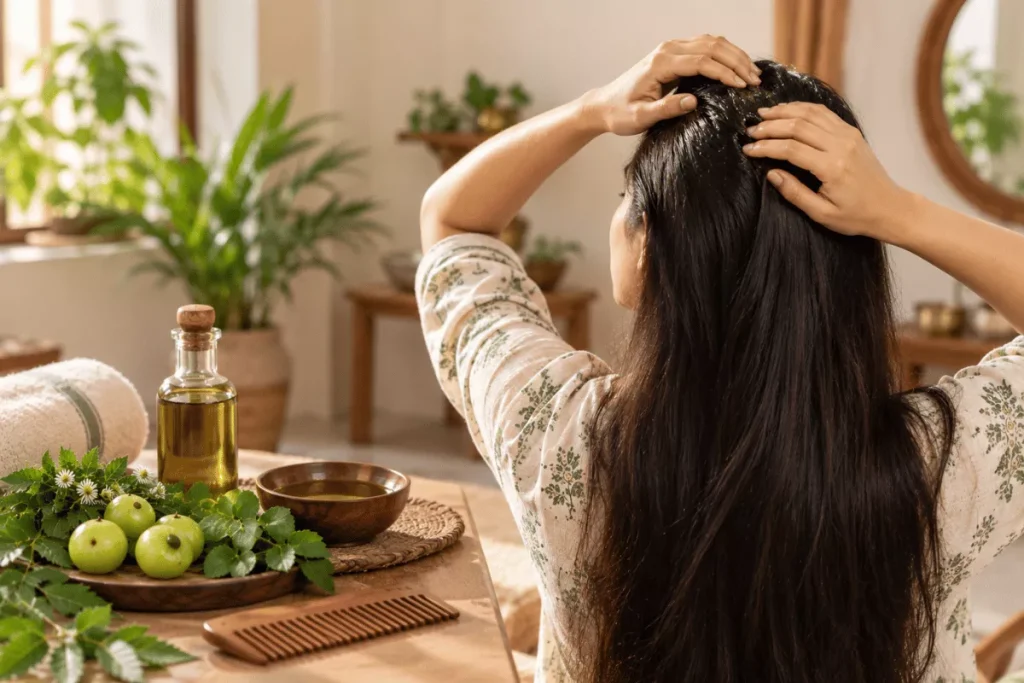
A simple oiling routine can look like this:
- Start with a relatively clean scalp. Heavy buildup can make it difficult to distribute the oil evenly.
- Take a moderate amount of oil. You do not need to soak the scalp.
- Apply directly to the scalp. Use your fingertips rather than scratching with your nails.
- Massage gently. Use light circular movements for a few minutes.
- Apply some oil to the lengths. This can help condition dry hair.
- Leave it according to the product instructions.
- Wash with a mild shampoo.
- Repeat consistently. A regular routine is more practical than applying a large amount occasionally.
For detailed application guidance, Kalera already has a separate guide on how to use Bhringraj Oil for hair growth, so this article can focus on the selection and hair-fall angle rather than repeating that entire tutorial.
How Often Should You Oil Your Hair?
There is no single schedule that works for everyone.
Some Ayurvedic hair oils recommend using them several times a week. Kalera’s Bhringraj Oil, for example, suggests 2–3 times a week, while another Bhringraj-based product such as Indulekha recommends three times a week.
A practical routine should consider:
- Your scalp type
- Hair thickness and length
- How frequently you wash your hair
- Whether oiling causes itching or buildup
- The directions provided with the product
If oiling makes your scalp uncomfortable, reduce the quantity or frequency rather than assuming more oil will produce better results.
Hair Fall or Hair Breakage: Why the Difference Matters
Not every strand found on your pillow represents hair loss from the root.
Hair can also break because of:
- Excessive heat styling
- Frequent chemical treatments
- Rough brushing
- Tight hairstyles
- Dry or damaged hair
- Friction
The American Academy of Dermatology notes that damaging hair-care practices and hairstyles that continuously pull on the scalp can contribute to hair loss or damage.
If the problem is mainly breakage, improving conditioning and reducing mechanical or chemical damage may be just as important as choosing a hair oil.
Can Ayurvedic Hair Oil Stop Severe Hair Fall?
It depends on why the hair is falling.
If the problem is related to a medical condition, hormonal changes, hereditary hair loss, nutritional deficiency, infection or medication, simply changing your hair oil may not address the underlying cause.
The American Academy of Dermatology recommends getting the cause of persistent hair loss identified because treatment depends on the diagnosis.
Seek professional advice if you notice:
- Sudden or rapid hair loss
- Bald patches
- A rapidly widening part
- A receding hairline
- Significant scalp itching, scaling or inflammation
- Hair falling out in large clumps
- Hair loss that continues despite improving your routine
You can read the American Academy of Dermatology’s hair-loss guidance for an overview of common causes and warning signs.
Simple Hair-Care Habits to Follow Alongside Oiling
Hair oiling works best as one part of a broader routine.
Try to:
- Eat a balanced diet with adequate protein and nutrients.
- Avoid very tight hairstyles.
- Limit unnecessary heat and chemical treatments.
- Use a gentle shampoo according to your scalp needs.
- Avoid aggressive scratching during scalp massage.
- Handle wet hair gently.
- Keep your scalp clean.
- Maintain a consistent routine instead of changing products frequently.
If you are already using Ayurvedic products internally, such as Ashwagandha Churna, remember that internal Ayurvedic products are different from topical hair oils and should be used according to their own directions.
Why Kalera Bhringraj Oil Can Be Considered for an Ayurvedic Hair-Care Routine
Kalera Bhringraj Oil is formulated around Bhringraj and includes Amla, Brahmi, Neem and Coconut Oil. The product is positioned for scalp nourishment, hair strength and regular Ayurvedic hair care.
The important point is not to treat one product as a universal answer to every type of hair loss. Instead, it can be considered when you specifically want a Bhringraj-led Ayurvedic oiling routine.
You can see the formulation and available sizes on the Kalera Bhringraj Oil product page.
Frequently Asked Questions
Which is the best Ayurvedic hair oil for hair fall?
There is no single Ayurvedic oil that is proven to be the best for every person or every type of hair loss. Bhringraj-based oils are commonly used in Ayurvedic hair care, while Amla, Brahmi, Neem and suitable carrier oils may also be included depending on the formulation. The right choice should match your scalp and hair-care needs.
Is Bhringraj oil good for hair fall?
Bhringraj is traditionally used for hair and scalp care, and preclinical research has investigated its potential hair-growth effects. However, the available evidence is not strong enough to claim that Bhringraj oil can treat every cause of hair loss.
Which is better for hair fall: Bhringraj or Amla?
Both are commonly used in Ayurvedic hair care, but they have different traditional roles. Bhringraj is more directly associated with hair and scalp care, while Amla is widely used for hair strength, conditioning and shine. Some formulations combine both ingredients.
How many times a week should I apply Ayurvedic hair oil?
It depends on the formulation and your scalp. Kalera Bhringraj Oil recommends 2–3 applications per week, while some other Bhringraj formulations recommend three times weekly. Always follow the instructions of the specific product.
Can hair oil regrow lost hair?
Hair oil should not be presented as a guaranteed hair-regrowth treatment. Hair loss has many possible causes, and some require medical treatment. An oil can be part of a scalp and hair-care routine, but persistent hair loss should be evaluated to determine the cause.
Is Ayurvedic hair oil suitable for men and women?
Many Ayurvedic hair oils can be used by both men and women, provided the product is intended for topical hair use and there are no individual contraindications. For persistent hair loss, the underlying cause matters more than gender.
Should I leave Ayurvedic hair oil overnight?
Not necessarily. Some products allow overnight use, while others recommend leaving the oil for a few hours. For example, Kalera’s Bhringraj Oil allows 1–2 hours or overnight, whereas Indulekha recommends 3–4 hours. Follow the directions for the specific product you use.
What should I do if my hair fall is sudden?
Do not rely only on hair oil. Sudden or significant hair loss can have several causes, including illness, stress, hormonal changes, nutritional deficiencies, scalp conditions or other medical issues. A dermatologist can help determine the cause and appropriate treatment.
Final Thoughts
The best Ayurvedic hair oil for hair fall is not necessarily the one with the longest ingredient list or the strongest marketing claim. Look for a thoughtfully formulated oil containing ingredients traditionally used for hair and scalp care, such as Bhringraj, Amla, Brahmi or Neem, along with a suitable carrier oil.
Bhringraj is a particularly relevant choice for a traditional Ayurvedic hair-care routine, but realistic expectations are important. Hair fall has many causes, and an oil cannot replace proper evaluation when shedding is persistent, sudden or severe.
For regular Ayurvedic scalp care, consistency, gentle application and a suitable formulation matter far more than simply using a large quantity of oil.