
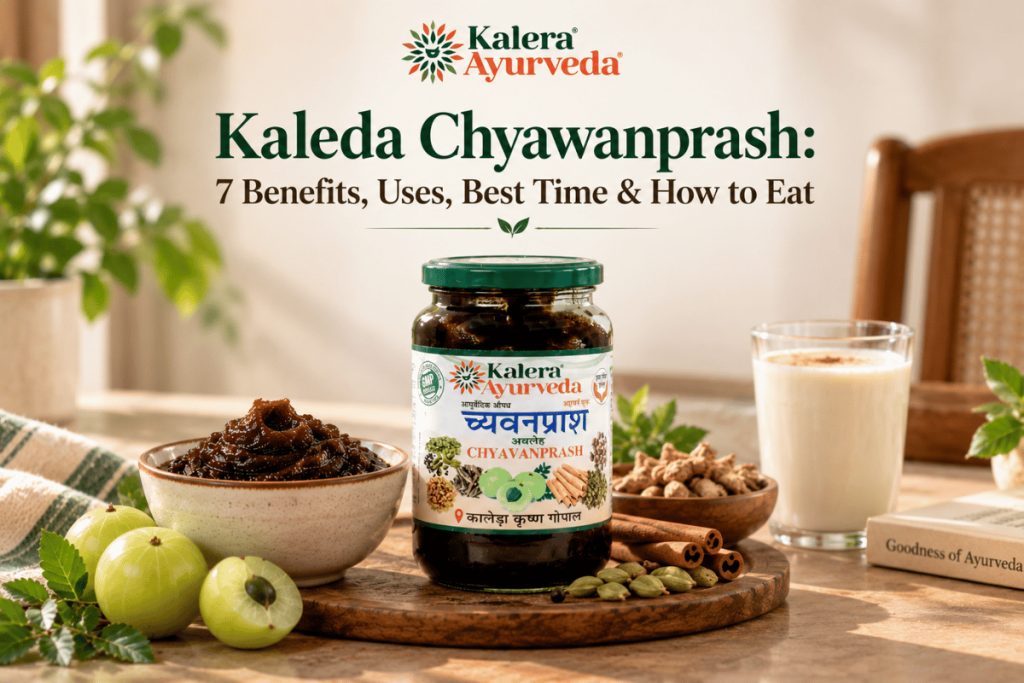
Kaleda Chyawanprash is a traditional Ayurvedic preparation in the form of an avaleha, a thick herbal formulation traditionally used as a rejuvenative preparation or Rasayana. Chyawanprash formulations generally contain amla along with a combination of herbs, spices and other ingredients, although the exact formulation can differ between manufacturers. A review published in Biomolecules describes Chyawanprash as a classical polyherbal preparation in which amla is a major ingredient.
Kalera Ayurveda describes its Chyawanprash as an Ayurvedic preparation containing ingredients such as amla, ghee, sesame oil and Ashtavarga herbs. The product is available as part of the brand’s Chyawanprash and Pak-Avaleh range.
But one important question remains: How should you actually take Chyawanprash, and when is the best time to eat it?
This guide explains the traditional uses, potential benefits, dosage, best time, different ways to consume it, precautions and answers to common questions about daily use.
What Is Kaleda Chyawanprash?
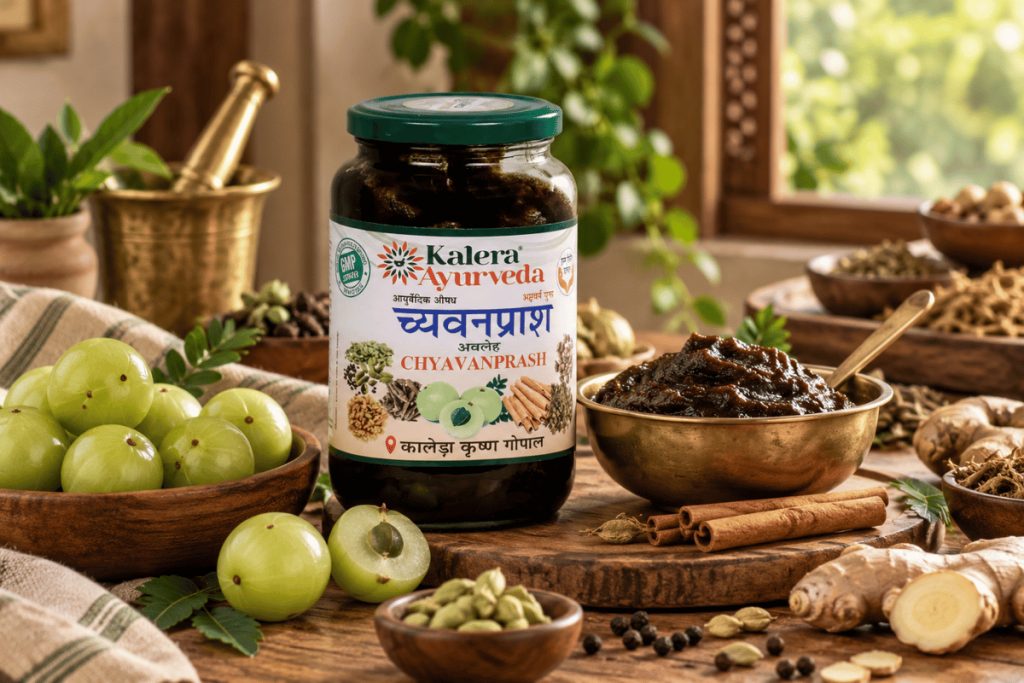
Chyawanprash is traditionally classified as an Avaleha, meaning a semi-solid herbal preparation. Classical formulations can contain numerous herbs and spices, with amla (Indian gooseberry) playing a central role. Research reviews note that traditional Chyawanprash recipes can contain many botanical ingredients and that formulations vary between products.
The Kalera Ayurveda formulation is described as containing amla, ghee, sesame oil and Ashtavarga herbs. Because Chyawanprash formulas can differ considerably, it is always better to check the ingredient list and serving instructions of the particular product rather than assuming that every Chyawanprash has the same composition.
If you are looking specifically for Kalera’s formulation, you can explore the Kalera Chyawanprash product page for its current ingredients and directions.
7 Kaleda Chyawanprash Benefits
Chyawanprash has traditionally been used as a Rasayana preparation for general nourishment and vitality. However, the exact benefits depend on the formulation, ingredients, quantity consumed and individual needs.
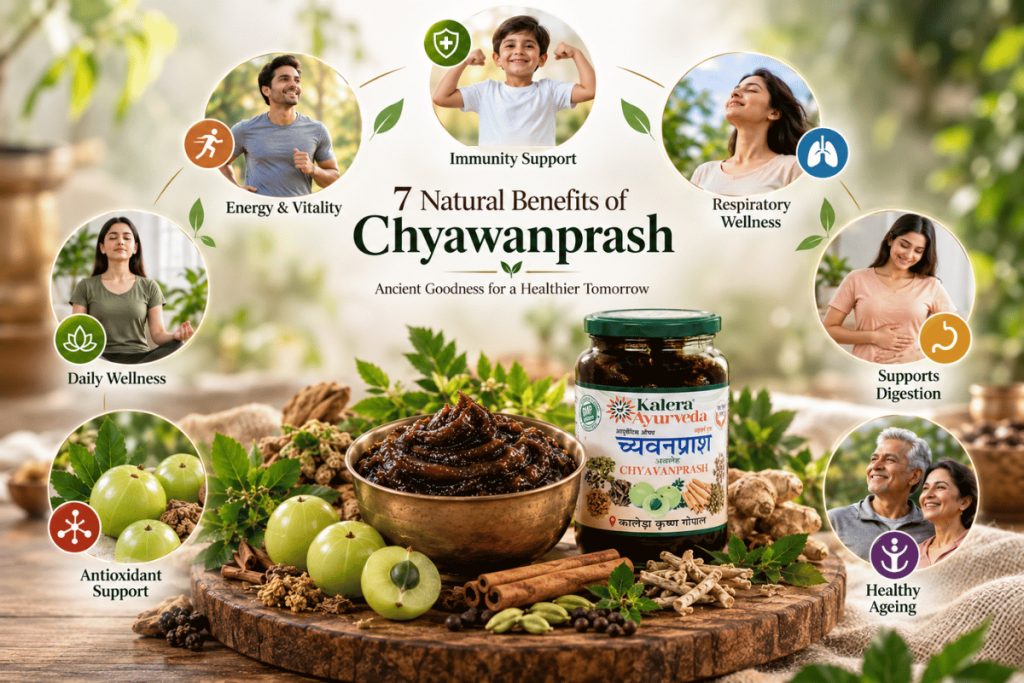
Here are seven commonly discussed areas of traditional use.
1. Supports Natural Immune Function
One of the best-known traditional uses of Chyawanprash is supporting the body’s natural defence mechanisms.
Amla and other herbs contribute plant compounds and antioxidants to the formulation. Research reviews have investigated Chyawanprash for immunomodulatory effects, although this does not mean that it should be considered a replacement for vaccination, prescribed treatment or medical care.
For everyday wellness, Chyawanprash is often included as part of a balanced diet and healthy routine, particularly during seasonal changes.
2. May Support Energy and Vitality
Chyawanprash is traditionally regarded as a nourishing Rasayana. Its combination of herbs, fats and other ingredients has historically been associated with maintaining strength, stamina and vitality.
This makes it particularly relevant for people looking for a traditional herbal preparation to complement a balanced diet, adequate sleep and regular physical activity.
However, persistent fatigue should not automatically be attributed to nutritional weakness. If tiredness continues for several weeks or is accompanied by other symptoms, it is better to discuss the cause with a healthcare professional.
3. Supports Respiratory Wellness
Several traditional Chyawanprash formulations contain herbs that are commonly associated with respiratory wellness.
Some research has explored Chyawanprash in relation to respiratory and immune markers, but the evidence is not sufficient to present it as a treatment for asthma, infections or other respiratory diseases.
For someone already following medical treatment for a respiratory condition, Chyawanprash should be viewed as a dietary or traditional Ayurvedic preparation rather than a substitute for prescribed medicines.
For people interested in Ayurvedic avaleha preparations specifically associated with respiratory wellness, Kalera Ayurveda also offers Vasavaleh.
4. Helps Complement Digestive Wellness
Digestive health is another area traditionally associated with Chyawanprash and its herbs.
The formulation contains multiple ingredients, and some of the herbs and spices traditionally used in Chyawanprash are also associated with digestion in Ayurveda. However, individual tolerance can vary.
Taking more than the recommended quantity does not necessarily provide greater benefits. In fact, excessive intake of a rich, sweet herbal preparation may cause heaviness or digestive discomfort in some people.
If digestion is your primary concern, Kalera Ayurveda’s Draksha Valeha is another Ayurvedic avaleha that the brand describes in relation to digestive comfort, energy and respiratory wellness.
5. Provides Antioxidant-Rich Herbal Ingredients
Amla is one of the most important ingredients in traditional Chyawanprash preparations. It contributes vitamin C and various plant compounds, while the wider herbal combination adds additional phytochemicals.
The antioxidant properties of individual ingredients are one reason Chyawanprash continues to attract scientific interest. However, antioxidant activity in a food or herbal preparation should not automatically be interpreted as proof that it prevents a particular disease.
6. Traditionally Used for Healthy Ageing
Chyawanprash is widely described in Ayurveda as a Rasayana, a category associated with rejuvenation, nourishment and maintaining vitality.
Traditional use therefore focuses less on a single symptom and more on supporting overall wellbeing. Modern research has investigated different aspects of Chyawanprash, but human clinical evidence remains variable and depends heavily on the particular formulation being studied.
7. Can Be Part of a Daily Wellness Routine
One of the practical advantages of an avaleha is that it can be incorporated relatively easily into a daily routine.
Depending on the product instructions, Chyawanprash can generally be taken directly or with a suitable warm beverage. Traditional sources commonly discuss morning consumption, particularly on an empty stomach.
The key is consistency and appropriate quantity rather than taking a large amount occasionally.
What Is the Best Time to Take Kaleda Chyawanprash?
For many people, morning is the traditional first choice.
A classical review describes a general Chyawanprash dosage taken with milk on an empty stomach in the morning, while other Ayurvedic guidance also commonly recommends morning consumption.
A practical routine can look like this:
Morning: Take the recommended quantity before breakfast, according to the product’s directions and your individual tolerance.
Before meals: Some Ayurvedic guidance discusses taking it before food, such as around 30 minutes beforehand.
Evening: Some commercial guidance allows Chyawanprash later in the day, although individual formulations and tolerability differ.
The most important point is not to assume that one timing works equally well for everyone.
Should You Take It on an Empty Stomach?
Traditional Ayurvedic references commonly describe Chyawanprash being taken on an empty stomach in the morning.
However, if taking it before food causes discomfort, follow the specific product directions or seek advice from an Ayurvedic practitioner.
How to Eat Kaleda Chyawanprash
There are several simple ways to consume Chyawanprash.
| Method | How to Take It |
|---|---|
| Directly | Take the recommended quantity using a clean spoon. |
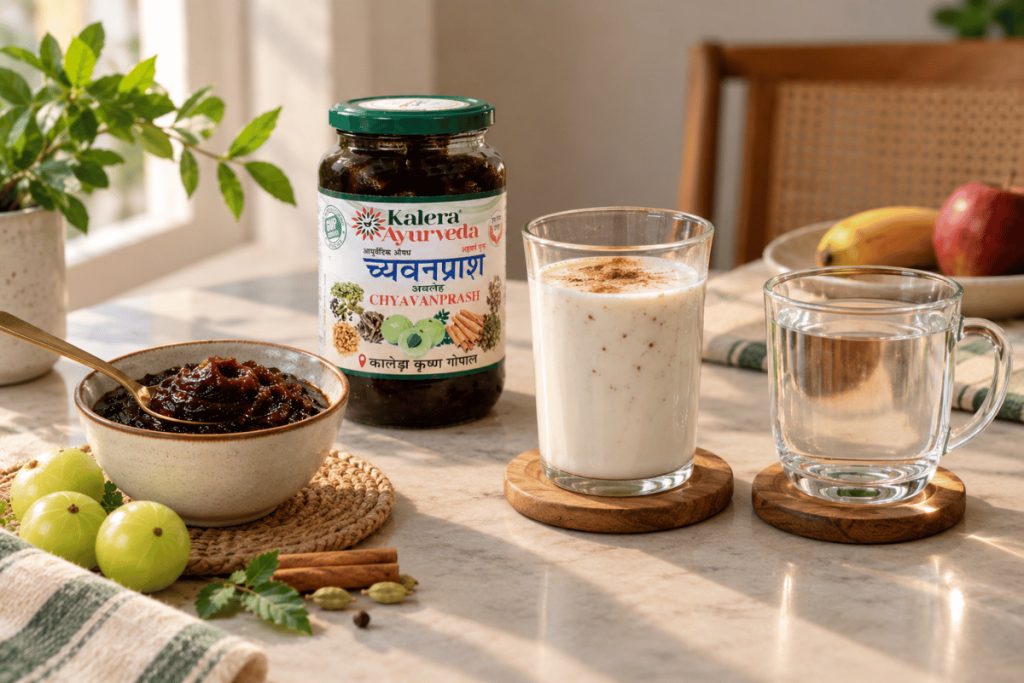
| With warm milk | Mix the serving with comfortably warm milk. |
| With lukewarm water | Useful if milk does not suit you. |
| Before breakfast | Traditionally taken before the first meal of the day. |
The classical literature specifically discusses taking Chyawanprash with milk and notes that lukewarm water can be used in situations where milk or curd is avoided, including certain respiratory conditions.
Avoid using very hot liquids. A comfortably warm beverage is sufficient.
How Much Kaleda Chyawanprash Should You Take?
There is no single universal dosage for every Chyawanprash product.
A classical review gives a general range of 12–28 g, commonly taken with milk in the morning, while commercial products often provide their own serving recommendations.
For example, some current Ayurvedic product guidance recommends around 1–2 teaspoons daily for adults, but the correct quantity should ultimately come from the product label or an Ayurvedic practitioner.
General Practical Guide
| Age group | Practical approach |
|---|---|
| Adults | Follow the product’s recommended serving; commonly 1–2 tsp is suggested by commercial guidance |
| Children | Use only an age-appropriate quantity and check the product label |
| Older adults | Start with the recommended quantity and consider individual digestion and tolerance |
| People with medical conditions | Consult a healthcare professional or qualified Ayurvedic practitioner |
Do not increase the serving simply because you want faster results.
Chyawanprash is a concentrated herbal preparation, and more is not necessarily better.
Can You Take Chyawanprash Every Day?
For many healthy individuals, Chyawanprash is traditionally used as part of a regular wellness routine. Classical literature describes its use across seasons and age groups, with quantity adjusted according to digestive capacity and appetite.
If you are taking it daily:
- Follow the product’s recommended serving.
- Do not exceed the suggested quantity.
- Pay attention to digestive tolerance.
- Maintain a balanced diet.
- Keep the jar properly closed and stored as instructed.
- Check the product label for ingredients and expiry information.
Daily use should complement healthy eating, exercise and adequate sleep rather than replace them.
Kaleda Chyawanprash With Milk or Water: Which Is Better?
Both can be practical options, depending on individual preference and tolerance.
With Warm Milk
Warm milk is a traditional accompaniment for Chyawanprash and can make the preparation easier to consume.
It may be especially convenient for people who already include milk in their diet.
With Lukewarm Water
Lukewarm water is a useful alternative for people who prefer not to take Chyawanprash with milk.
The classical literature specifically mentions lukewarm water as an alternative in certain circumstances.
If milk does not suit you, there is no need to force yourself to use it.
Is Chyawanprash Suitable for Children?
Chyawanprash is commonly marketed for different age groups, but children should receive an age-appropriate quantity rather than an adult serving.
Some commercial Ayurvedic guidance suggests smaller quantities for children, but recommendations vary between products.
Parents should therefore:
- Check the specific product label.
- Avoid giving an adult serving to a child.
- Consider allergies and dietary restrictions.
- Seek professional advice if the child has an ongoing medical condition or takes medication.
Is Chyawanprash Good for Older Adults?
Older adults may include Chyawanprash as part of a broader nutrition and wellness routine when it is appropriate for them.
Because digestion, medication use and underlying health conditions can change with age, the serving should not simply be increased without guidance.
For older adults with specific nutritional or vitality goals, it is better to choose an Ayurvedic preparation according to individual needs rather than assuming that every herbal product is suitable.
What About Sugar in Chyawanprash?
This is an important point that is sometimes overlooked.
Many conventional Chyawanprash preparations contain sweetening ingredients. Therefore, people who are monitoring their blood glucose should check the product’s ingredient list and nutrition information rather than assuming that a product is sugar-free.
If you have diabetes or are following a medically supervised low-sugar diet, discuss the product with your doctor or dietitian before adding it regularly to your routine.
Kalera Ayurveda also offers Shaktiprash, which the brand describes as an Ayurvedic avaleha formulated for vitality, strength and immunity and says is suitable for diabetic individuals when taken as advised.
Kaleda Chyawanprash vs Other Ayurvedic Avaleha Preparations
Chyawanprash is not the only Ayurvedic avaleha available.
Different preparations have different ingredient combinations and traditional purposes.
For example:
- Chyawanprash – traditionally associated with Rasayana, vitality and general wellness.
- Draksha Valeha – Kalera describes it in relation to digestion, energy and respiratory wellness.
- Shaktiprash – positioned by Kalera for strength, vitality and immunity.
- Swarn Yukt Chyawanprash – a variant of Chyawanprash with additional ingredients; check its specific product formulation and directions before use.
If you are interested in a more premium Chyawanprash formulation, you can see Kalera Swarn Yukt Chyawanprash and compare its ingredients and serving directions with the standard preparation.
Who Should Be Careful With Chyawanprash?
Although Chyawanprash is traditionally used as a health supplement, it should not be treated as automatically suitable for everyone.
Take extra care if you:
- Have diabetes or need to strictly control sugar intake.
- Have a known allergy to any ingredient.
- Are pregnant or breastfeeding.
- Have kidney, liver or other chronic health conditions.
- Take multiple prescription medicines.
- Have a digestive condition that makes rich or sweet preparations difficult to tolerate.
If you have a diagnosed health condition, ask your healthcare professional or qualified Ayurvedic practitioner whether the specific formulation is appropriate for you.
Also remember that Chyawanprash should not replace prescribed treatment for infections, asthma, diabetes or other medical conditions.
How to Store Chyawanprash Properly
Good storage helps maintain the quality of an avaleha.
Keep the container:
- Tightly closed after every use.
- In a cool, dry place.
- Away from direct sunlight and excessive heat.
- Away from moisture.
- Within the manufacturer’s stated shelf-life period.
Always follow the storage instructions printed on the product packaging.
A published review has also noted that Chyawanprash formulations can undergo changes during storage, highlighting why the manufacturer’s expiry and storage instructions should be followed rather than relying on a generic shelf-life assumption.
What Does Research Say About Chyawanprash?
Chyawanprash has a long history of traditional use and has been the subject of scientific research.
A detailed review published in Biomolecules describes it as a classical polyherbal Ayurvedic preparation and summarizes research concerning its phytochemistry, traditional uses and potential biological effects.
At the same time, research quality and formulations vary. Different commercial products may contain different ingredients and proportions, so results from a study of one formulation should not automatically be applied to every Chyawanprash available in the market.
This distinction is important when reading claims about immunity, respiratory health, ageing or other specific outcomes.
Frequently Asked Questions
1. What is Kaleda Chyawanprash used for?
Kaleda Chyawanprash is a traditional Ayurvedic avaleha used as a Rasayana preparation for general nourishment, vitality and wellness. Chyawanprash formulations are commonly associated with immune support, energy, digestion and healthy ageing, although the exact properties depend on the formulation and ingredients.
2. What is the best time to take Kaleda Chyawanprash?
Morning is traditionally considered a suitable time, particularly on an empty stomach. Classical Ayurvedic literature describes Chyawanprash being taken in the morning with milk, while other guidance discusses taking it before meals.
3. Can I take Chyawanprash with milk?
Yes. Warm milk is a traditional way to consume Chyawanprash. If milk does not suit you, lukewarm water can be used instead.
4. How much Chyawanprash should an adult take daily?
The appropriate quantity depends on the specific formulation. Classical literature discusses a general range of 12–28 g, while many commercial products recommend approximately 1–2 teaspoons daily. Always follow the serving instructions of the product you are using.
5. Can children take Chyawanprash?
Children may be given age-appropriate servings with suitable products, but the quantity should be much lower than an adult serving. Parents should follow the product label and consult a healthcare professional when the child has allergies, medical conditions or takes regular medication.
6. Can I take Chyawanprash every day?
Chyawanprash has traditionally been used regularly as a Rasayana. For everyday use, follow the recommended quantity and monitor how your body responds. Taking a larger amount does not necessarily provide additional benefits.
7. Is Chyawanprash good for immunity?
Supporting natural resistance and immunity is one of the most widely discussed traditional uses of Chyawanprash. Some research has explored its immunomodulatory properties, but it should not be considered a substitute for vaccination, medical treatment or other evidence-based preventive measures.
8. Can I take Chyawanprash if I have diabetes?
Do not assume that regular Chyawanprash is sugar-free. Many formulations contain sweetening ingredients. If you have diabetes, check the exact formulation and discuss regular use with your healthcare professional.
9. Can Chyawanprash be taken with water?
Yes. Lukewarm water is a commonly discussed alternative to milk, particularly for people who do not consume milk or for whom milk may not be suitable.
10. Does everyone need the same Chyawanprash dosage?
No. Dosage can vary according to the formulation, age, digestive capacity, dietary habits and individual health needs. The product label should be the first reference for the specific preparation you are using.
Final Takeaway
Kaleda Chyawanprash can be understood as a traditional Ayurvedic avaleha rather than simply another everyday sweet spread. Its foundation in amla and multiple herbs gives it a distinctive place in the Ayurvedic Rasayana tradition.
Its commonly discussed traditional uses include supporting general vitality, natural immune function, digestive wellness, respiratory wellness and healthy ageing. However, the formulation, serving size and individual suitability matter, and scientific evidence does not justify treating Chyawanprash as a cure for specific diseases.
For most people considering it as part of a wellness routine, the sensible approach is simple: choose the appropriate formulation, follow its recommended serving, take it consistently, and pay attention to your individual tolerance.
If you are comparing Ayurvedic avaleha preparations, you can also explore Kalera Ayurveda’s Pak-Avaleh collection to see how different formulations are positioned for different wellness needs.